 ultimate-guide
Printing Small Batches of Multi Color Shirts: 2026 Guide
Table of Contents
- Why Small-Batch Multi Color Shirt Printing Is Finally Affordable
- DTF vs Screen Printing for Small Orders
- How to Prepare Artwork for DTF Printing
- Affordable Custom Hoodies for Small Teams
- Choosing the Right Fabric for Multi Color Shirts
- Sublimation and Thermal Transfer Printing Methods
- Cost-Per-Unit, Setup Fees, and Turnaround Times
- Frequently Asked Questions
Last Updated: September 10, 2026
Why Small-Batch Multi Color Shirt Printing Is Finally Affordable
Printing small batches of multi color shirts used to mean one thing: paying setup fees that made no sense for 25 shirts. That math has changed. Digital methods have rewritten what's possible for small runs, and the shift matters most for teams ordering between 10 and 100 pieces.
Multi color shirts are garments printed with two or more ink colors or design elements in a single run. The old rule was simple: more colors meant more screens, more setup, and more cost. Digital printing broke that link.
Most operations managers and event coordinators don't need thousands of shirts. They might need 30 hoodies for a trade show booth or 60 tees for a staff event. For years, such requests often faced pricing challenges. That's changing.
What Counts as a Small Batch (10-100 Units)
A small batch is typically 10 to 100 units, though the practical ceiling depends on the method (sba.gov). Below 10 units, most shops treat the order as a sample run. Above 100, screen printing's economics start to make sense.
The batch size you choose drives everything: which printing method works, what your cost-per-unit looks like, and how long turnaround takes. Get this number right before you request quotes.
The Hidden Costs Nobody Warns You About
The sticker price is never the real price. Setup fees, screen charges, color-matching runs, and rush turnaround surcharges pile on top of the per-shirt quote.
- Screen setup fees: charged per color, per design, whether you order 12 shirts or 1,200
- Artwork prep: converting a raster logo into a print-ready vector file costs money if you can't do it yourself
- Rush fees: expedited turnaround often adds a percentage to the total
- Overruns and underruns: screen printing shops sometimes deliver slightly more or fewer units than ordered
DTF vs Screen Printing for Small Orders
For small orders, DTF (Direct to Film) printing beats screen printing on cost and flexibility. Screen printing wins only when volume climbs past roughly 100 units or the design uses one or two colors.
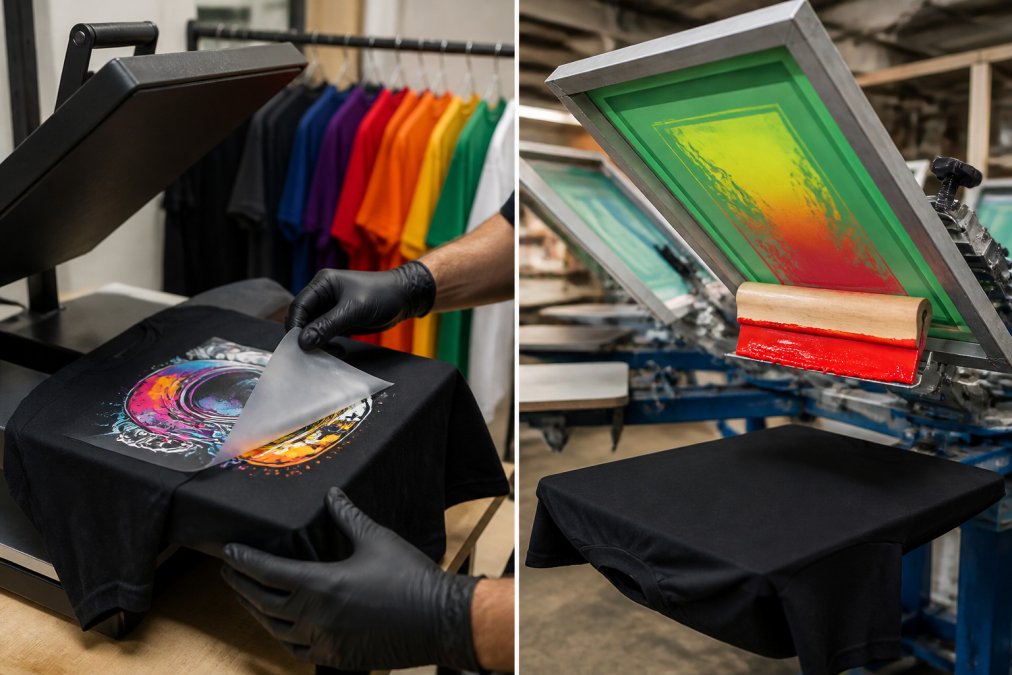
DTF works by printing your design onto a film, then heat-pressing that film onto the garment. No screens, no per-color setup, no minimum order. A 7-color design costs the same to set up as a 1-color design. That single fact changes the math for multi color shirts.
Screen printing requires a separate mesh screen for every color (printwiki.org). A 7-color logo means 7 screens, 7 setup fees, and 7 passes through the press. At 500 units, that cost spreads thin. At 50 units, it doesn't.
When Screen Printing Still Wins
Screen printing remains the better choice for large runs, simple designs, and long-term durability on cotton. If you're ordering 250+ single or two-color shirts, screen printing's per-unit cost drops below DTF. The plastisol ink also sits on top of the fabric in a thicker layer that many buyers prefer for bold, solid-color logos.
For teams ordering under 100 units with detailed or multi-color artwork, DTF is the practical answer.
Durability and Wash Testing by Method
Wash durability depends on the method, the fabric, and how the print was applied. The mechanism matters more than the marketing claim.
DTF presses a cured ink layer onto the garment through an adhesive film. When pressed correctly, the bond holds through many wash cycles. When it fails, it usually fails at the edges first, where the film can lift if the press temperature or pressure was off. Turning garments inside out and washing cold extends the life of any transfer.
Screen-printed plastisol is cured into the fabric at high heat, so the ink and the cotton fibers interlock. It can last the life of the shirt. The trade-off is that plastisol sits on top of the fabric as a thicker layer, which can crack over time on stretchy knits or if the ink was under-cured.
Sublimation dyes the fabric itself, so there's nothing to crack or peel. It typically does not wash out because the color is part of the fiber. The catch is that it only works on polyester or high-polyester blends, and only on light-colored garments unless you use a colored base.
Thermal transfer presses a pre-printed design onto the garment. It works on cotton and blends and feels soft, but it can be less durable of the four over many washes because the transfer layer can lift at the edges.
| Method | Best Batch Size | Multi-Color Cost | Wash Durability | Fabric Match |
|---|---|---|---|---|
| DTF | 10-100 units | Low, no per-color fee | Good, many washes | Cotton, blends, polyester |
| Screen printing | 100+ units | High setup per color | Excellent, can last the life of the shirt | Cotton, blends |
| Sublimation | Any size | Low | Excellent, dyed-in | Polyester, light colors |
| Thermal transfer | 10-200 units | Low | Moderate | Cotton, blends |
How to Prepare Artwork for DTF Printing
Print-ready artwork is the difference between a crisp print and a blurry one. DTF accepts more file types than screen printing, but the quality of your source file still determines the final result.
Start with a high-resolution file, and avoid upscaling a low-resolution image to fix it. Upscaling adds pixels, not detail.
Vector Graphics vs Raster Images
Vector graphics use math to define shapes, so they scale to any size without losing sharpness. Logos, text, and simple shapes should always be vectors.
Raster images are built from pixels. Photos and detailed illustrations are rasters. They have a fixed resolution, and blowing them up past their native size produces blur and jagged edges.
Multi-Color Separation and File Formats
For DTF, you generally don't need to separate colors manually. The printer handles full-color output from a single file. That's a major advantage over screen printing, which requires each color to be isolated into its own layer for a separate screen.
Send your printer a vector file (AI, EPS, or PDF) when possible. For raster artwork, supply a PNG at 300 DPI or higher at the final print size (adobe.com). Avoid JPEGs, which compress and degrade image quality.
Affordable Custom Hoodies for Small Teams
Hoodies are the highest-demand small-batch item for teams, schools, and camps, and they're also where cost-per-unit varies most. A heavyweight fleece hoodie costs more to source than a basic tee, so the printing method matters even more to your total.
For a 20-person team, DTF on a mid-weight cotton-blend hoodie delivers full-color branding without setup fees. For a 200-unit order, screen printing a two-color logo on the same hoodie brings the per-unit cost down.
The choice comes down to design complexity and volume. Intricate multi-color art favors DTF at any batch size. Simple logos favor screen printing once you cross the volume threshold.
Choosing the Right Fabric for Multi Color Shirts
Fabric compatibility decides which printing method you can use. Get this wrong and the best design in the world won't adhere properly.
Cotton and cotton blends accept DTF, screen printing, and thermal transfer well. They're the safest choice for multi color shirts because nearly every method works on them.
Polyester Tees, Cotton Blends, and Sublimation
Polyester is the only fabric that works with sublimation, and it must be light-colored for the dye to show. Sublimation produces no texture on the surface, so the design feels like part of the shirt.
The catch: sublimation on dark polyester typically requires a white base layer, which adds a step and cost. For dark garments, DTF or screen printing can be a more suitable route.
Sublimation and Thermal Transfer Printing Methods
Sublimation and thermal transfer are two different technologies that both use heat, and they're often confused. Knowing which is which helps you pick the right method.
Sublimation printing converts solid dye into gas that bonds with polyester fibers, so the color becomes part of the fabric. It typically does not crack or peel because there's no layer sitting on top.
Thermal transfer printing presses a pre-printed design onto the garment using heat and pressure. It works on cotton and blends, and it's a common choice for small runs where you want a soft feel.
Both methods handle full-color design without color separation. Sublimation is limited to polyester and light colors. Thermal transfer is more flexible on fabric but generally less durable over many washes than sublimation.
Cost-Per-Unit, Setup Fees, and Turnaround Times
Cost-per-unit falls as batch size rises, but the curve is steeper for screen printing than for digital methods. This is the single most important fact in small-batch ordering, and it's also where most quotes hide their real number.
The Hidden Costs Nobody Quotes Up Front
The sticker price is never the real price. When you compare a DTF quote against a screen-print quote for the same 50 shirts, the screen-print number usually looks lower until you add the line items below.
- Screen setup fees: charged per color, per design, per location. A 6-color front print on a 50-shirt run can carry six separate setup charges before a single shirt is printed. DTF and DTG carry no per-color setup.
- Artwork prep: converting a raster logo into a print-ready vector file is billable work if you can't do it yourself. Screen printing also requires each color to be separated into its own layer, which adds prep time. DTF prints full-color from one file, so separation isn't needed.
- Rush fees: expedited turnaround typically adds a percentage to the total, and the percentage climbs the tighter the deadline. Screen printing needs a setup day before the first shirt prints, so rush orders compress an already short window.
- Overruns and underruns: screen printing shops sometimes deliver slightly more or fewer units than ordered because the press run is set up in fixed increments. Digital methods print one piece at a time, so what you order is what you get.
- Shipping and split delivery: if your shirts ship to multiple addresses, per-box charges stack up fast on small runs where the per-unit price is already high.
How the Cost Curve Actually Behaves
Screen printing front-loads cost into setup. Once screens are made, each additional shirt is cheap, which is why a 500-unit order can cost less per shirt than a 50-unit order. DTF spreads cost differently: no screens, but a higher per-piece material cost that stays roughly flat across the run.
The practical crossover is a common pattern: below roughly 100 units, digital methods usually win on total cost for multi-color work; above that, screen printing's falling per-unit cost overtakes it, especially for one- and two-color designs.
Turnaround Times by Method
Turnaround varies by method because the prep steps differ.
| Method | Typical Prep Before First Print | Best For |
|---|---|---|
| DTF | Same day to next day (no screens) | Tight deadlines, complex art |
| DTG | Same day to next day | Cotton, on-demand runs |
| Screen printing | One setup day or more | Larger runs, simple art |
| Sublimation | Same day to next day | Polyester, light colors |
For event deadlines, factor that setup gap into your timeline. A screen-printed order placed a week out may still miss the date once setup and shipping are added; a DTF order placed the same day often ships sooner.
Pricing depends on quantity, design complexity, fabric choice, and delivery date. Request a quote with your exact batch size and artwork so you get an accurate number rather than a rough estimate, and ask the shop to itemize setup, art prep, and rush charges separately so you can compare quotes apples to apples.
Frequently Asked Questions
Is it cheaper to print shirts in bulk or in small batches?
Bulk orders lower the cost-per-unit because setup fees and screen preparation spread across more shirts. For small batches of 10-100 multi color shirts, the gap has narrowed thanks to DTF and digital printing, which skip screen setup entirely. If your design has many colors, small-batch digital methods often beat screen printing on total cost. Request a quote with your exact quantity and color count to compare pricing for your specific run.
How does DTF printing compare to screen printing for small batches?
DTF handles full-color designs without per-color setup fees, making it a strong fit for small orders with intricate artwork. Screen printing requires a separate screen for each color, so a 7-color logo on 50 shirts carries heavy setup costs. However, screen printing can offer excellent wash durability on long runs. For batches under 100 units with multi-color designs, DTF can often be more cost-effective and offer faster turnaround; screen printing can be more economical for large runs.
How do I prepare my artwork for multi-color small batch printing?
Start with vector graphics (AI, EPS, SVG) whenever possible, since they scale without losing sharpness. For raster images, use 300 DPI at the final print size. Consider converting all colors to a consistent color profile, and removing backgrounds if the design will sit on a colored garment. For DTF, flattening the file with a transparent background and ensuring fine details are at least 1-2 mm thick can be beneficial. It's often helpful to send a mockup to your printer before production to help catch potential color mismatches.
Can I get high-quality multi-color prints without a high minimum order quantity?
Yes. DTF, DTG, and sublimation printing all handle multi-color designs without per-color setup fees, so minimums can be as low as a single shirt. Screen printing typically requires 12-24 units minimum to justify screen costs. For teams ordering 10-50 custom hoodies or event shirts, digital methods deliver vibrant, full-color results with no minimum order penalty. Always confirm the exact minimum with your printer before finalizing the design.
Ordering multi color shirts in small batches no longer means accepting inflated per-unit costs or blurry prints. The right method, matched to your batch size and fabric, delivers professional results at a price that works. Action Designs handles screen printing, DTF, DTG, and embroidery, supplies garments or prints on items you provide, and scales from a single shirt to a full collection. Get a quote from Action Designs and see exactly what your next run will cost.