 comparison
Is DTG Printing Worth It for Small Businesses? 2026 Review
Table of Contents
- DTG Printing at a Glance: Costs, Quality, and Fit for Small Shops
- DTG vs DTF Printing: Which Method Fits Your Production Model?
- DTG vs Screen Printing: Where Each Method Wins
- DTG Printing Profit Margins: What Small Shops Actually Earn
- Maintenance Costs for DTG Printers: The Ongoing Expense Owners Forget
- Total Cost of Ownership: Equipment, Space, and Workflow Automation
- Verdict: Is DTG Printing Worth It for Your Small Business?
- Frequently Asked Questions
Last Updated: September 16, 2026
DTG Printing at a Glance: Costs, Quality, and Fit for Small Shops
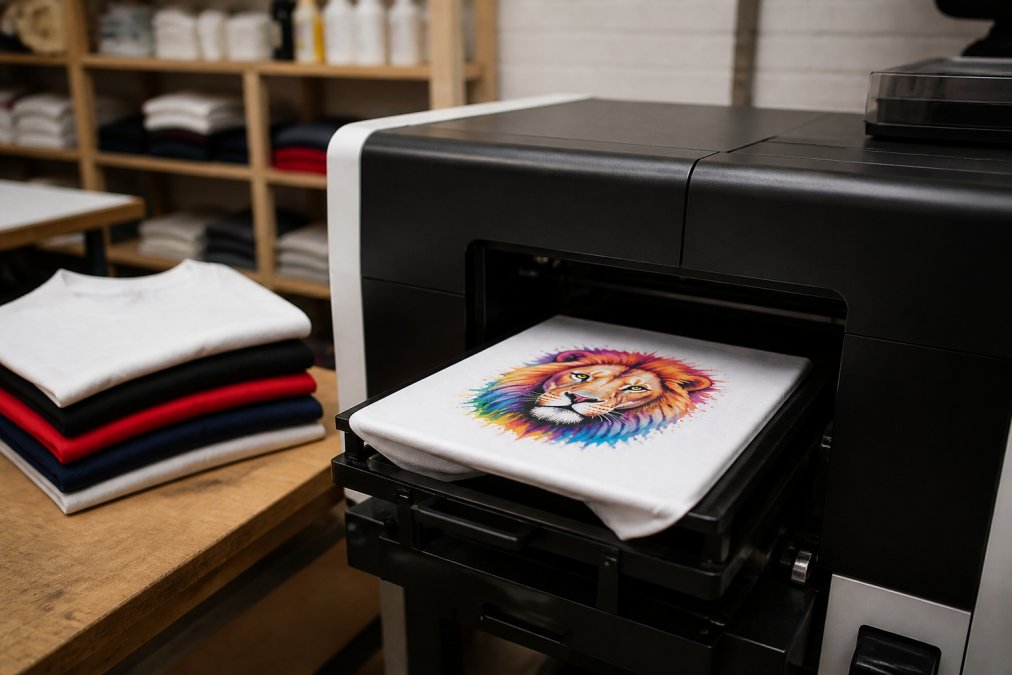
Direct-to-garment (DTG) printing jets water-based pigment inks directly onto a garment, making it the most accessible entry point into custom apparel for small businesses testing designs without bulk inventory. Is DTG printing worth it for small businesses? Yes, if your orders are small-batch, design-heavy, and time-sensitive. No, if you are chasing the lowest cost per unit on large runs. This guide from Action Designs breaks down the real economics, the operational overhead nobody warns you about, and when DTG pays for itself.
| Factor | DTG | DTF | Screen Printing |
|---|---|---|---|
| Setup per design | None | None | Screen per color |
| Best order size | 1-50 units | 1-100 units | 50+ units |
| Color limits | Unlimited (CMYK) | Unlimited | Cost per color |
| Fabric range | Cotton-heavy | Broad | Broad |
| Per-unit cost at scale | Higher | Moderate | Lowest |
DTG vs DTF Printing: Which Method Fits Your Production Model?
DTG vs DTF printing comes down to fabric flexibility versus hand feel. DTF (direct-to-film) prints onto a transfer film, cures it, then heat-presses it onto the garment. DTG prints directly onto the fabric.
DTG vs Screen Printing: Where Each Method Wins
Screen printing wins on cost per unit at volume; DTG wins on flexibility and turnaround. For 200+ shirts in one or two colors, screen printing is almost always cheaper per shirt. For 12 shirts with a seven-color logo, screen printing setup costs can make the order uneconomical, while DTG handles it in a single pass.
DTG Printing Profit Margins: What Small Shops Actually Earn
- Start with landed blank cost. Your blank plus inbound freight, divided by units. Buying in case or pallet quantities lowers this line, but only if the sizes and colors actually sell through.
- Add ink and pre-treatment per print. Estimate from your artwork's coverage, not an average. Track real jobs by counting prints per ink cartridge and pre-treatment refill to build your own cost-per-print figure rather than trusting a spec sheet.
- Add labor at a real rate. Pre-treating, loading, printing, curing, folding, and packing are separate steps. Time each on a normal order and multiply by a wage you would actually pay someone.
- Add failure and reprint allowance. Misprints, clogged nozzles mid-job, and customer rejects happen. A small percentage buffer on every order keeps those events from eating your margin.
- Apply your markup to the sum, not to the blank. Marking up only the garment is the most common small-shop pricing error.
The levers that move margin most:
- Blank garment cost, buy in volume to lower per-unit cost, but avoid dead stock in slow sizes
- Ink cost per print, varies with image coverage; heavy prints cost more, so price them higher
- Pre-treatment, a per-print consumable that scales with print area, not with order size
- Labor time, pre-treatment and pressing are the hidden hours that decide whether a job is profitable
- Pricing strategy, charge for the design work and the flexibility, not just the print
One structural advantage small shops have: because DTG has no setup cost, you can accept a 6-shirt order at a price that would be unprofitable for a screen printer, and charge a small-batch premium for it. That premium, not the per-unit print cost, is where most home-based DTG shops actually make their money.
Maintenance Costs for DTG Printers: The Ongoing Expense Owners Forget
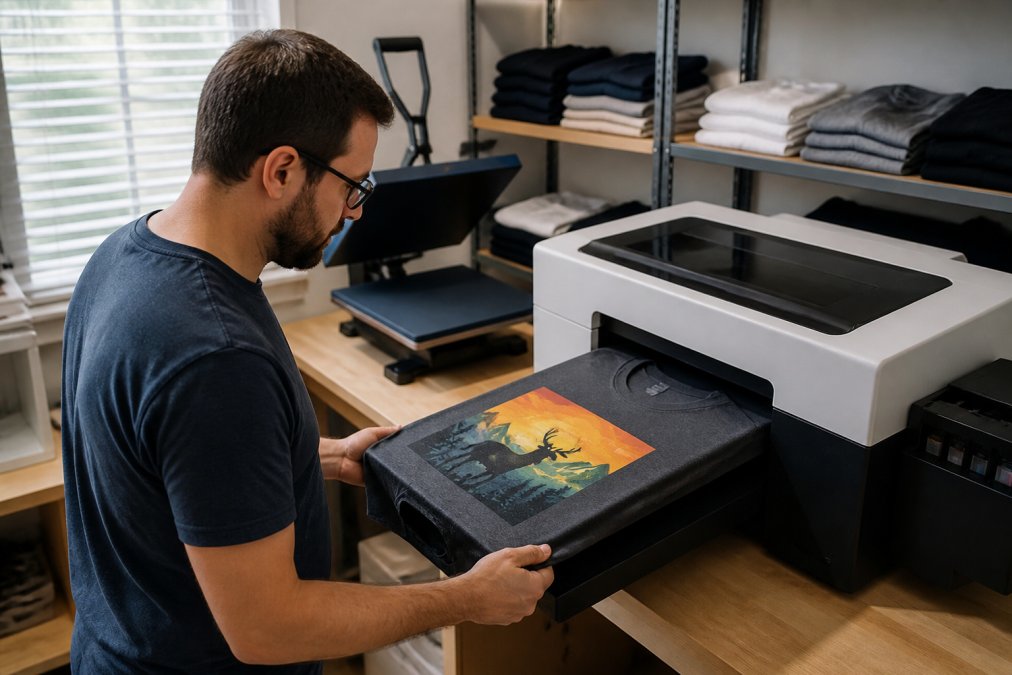
Maintenance costs for DTG printers are the single most underestimated line item. DTG machines use water-based pigment inks that dry and clog print heads if left idle. White ink circulation, daily print head cleaning, and regular capping station maintenance are not optional, they are the difference between a printer that lasts and one that fails in year two.
Budget for:
- Daily maintenance, 5 to 15 minutes of cleaning and ink circulation
- Weekly deep clean, flushing lines, checking wiper blades
- Consumables, cleaning solution, capping station parts, wiper blades
- Print head longevity, a well-maintained head lasts years; a neglected one can fail in months
Neither eliminates the routine.
Total Cost of Ownership: Equipment, Space, and Workflow Automation
Total cost of ownership for a DTG setup includes far more than the printer sticker price. Most buyers budget for the machine and heat press, then discover the recurring and environmental costs decide whether the shop is viable. The ownership stack breaks into four buckets: capital, consumables, environment, and workflow.
-
Ink, including white ink, which is consumed both by printing and by the daily circulation cycles that keep the print head from clogging
-
Pre-treatment fluid, a per-print consumable that scales with print area
-
Cleaning solution and maintenance supplies, wiper blades, capping station parts, and flush fluid
-
Waste ink, the ink purged during maintenance cycles, which is a real cost even on days you print nothing
-
Electricity, the printer, heat press, and any climate control all draw power, and a home shop on a residential rate will feel it
-
Blanks and freight, the largest recurring line for most shops
-
Footprint. A DTG printer, heat press, pre-treatment station, and staging area for blanks and finished goods need more floor space than the spec sheet implies. Plan for a dedicated room or garage bay, not a corner of a living space.
-
Ventilation. Pre-treatment spray and curing both release fumes. A home shop needs real ventilation, an exhaust fan or a spray booth, not just an open window.
-
Temperature and humidity. DTG printers need stable conditions. Low humidity dries ink in the nozzles and accelerates clogging; high humidity affects curing and print consistency. A shop without climate control will fight seasonal print quality drift.
-
Power. The printer plus a heat press on the same circuit can trip a residential breaker. Confirm your circuit capacity before the machine arrives.
-
Water and drainage. Pre-treatment and cleaning generate wastewater. A utility sink or a plumbed station makes daily maintenance far less painful.
-
Automated maintenance cycles that run on a schedule instead of relying on the operator to remember
-
Quick-change platens that cut setup time between garment types
-
RIP software integration that handles color management and file preparation, so the operator is not manually adjusting every job
-
Wet-on-wet printing on higher-end machines, which removes a curing step between colors and speeds up multi-color work
| Machine | Best For | Standout Feature | Watch Out For |
|---|---|---|---|
| Epson SureColor F1070 | Entry-level shops | Hybrid DTG/DTF, compact | Regular maintenance required |
| Ricoh Ri 1000 | Ease of use | Touchscreen, quick-change platens | Higher ink cost at volume |
| Brother GTXpro | Efficiency | Fast print mode, wide gamut | Needs dedicated climate control |
| Kornit Atlas MAX | Scaling up | Automation, high speed | Significant capital investment |
Verdict: Is DTG Printing Worth It for Your Small Business?
DTG printing is worth it for small businesses selling design-led, small-batch custom apparel that value turnaround speed over the lowest cost per shirt. It is not worth it if your model is high-volume, single-color runs where screen printing always wins on price.
Frequently Asked Questions
What are the disadvantages of DTG printing for small businesses?
DTG printing requires a significant upfront investment in equipment, plus ongoing maintenance like daily print head cleaning and white ink circulation to prevent clogging. Ink costs run higher than screen printing on large runs, and results vary by garment substrate, with 100% cotton typically performing best. Pre-treatment is also required for dark shirts, adding a step before printing. For small businesses weighing whether DTG printing is worth it, these operational demands matter as much as the sticker price.
Is DTG printing more cost-effective than screen printing for low-volume orders?
For small batch production, DTG usually wins on setup costs. Screen printing requires a separate screen for each color, so a 7-color logo on 200 shirts carries substantial setup expenses before the first print. DTG skips screens entirely, printing directly from a digital file. That makes DTG printing a better fit for short runs, one-off customization, and print-on-demand models. At high volumes, screen printing's lower ink cost per print typically flips the math in its favor.
How do DTG printing profit margins compare to DTF printing?
DTG and DTF carry different cost structures. DTF requires a heat press and transfer film, which can lower equipment entry costs, but film and powder add per-print expense. DTG has higher machine investment but no transfer materials. Profit margins for both depend on garment cost, ink cost per print, and pricing strategy. Shops pricing custom apparel in the $18-$30 range often see healthier margins on DTG for cotton-heavy orders and on DTF for polyester blends or hard-to-print fabrics.
What maintenance costs should I expect with a DTG printer?
Maintenance costs for DTG printers include daily print head cleaning, white ink circulation to prevent settling, and periodic replacement of capping stations, wipers, and ink lines. Budget for cleaning solution, waste ink, and occasional print head replacement, which is the largest single maintenance expense. Climate control matters too, since temperature and humidity swings affect print consistency. Skipping daily maintenance shortens print head longevity, which raises your long-term cost per print significantly.
Can DTG printing handle intricate designs with fine details?
Yes. DTG printing handles fine lines, gradients, and photorealistic prints well. It supports vibrant, detailed artwork without the color separation work screen printing demands. The main limitation is garment substrate: 100% cotton produces the sharpest results, while high-polyester blends may need a different method like DTF for comparable detail retention.