 comparison
Underground Shirts Alternatives for Corporate Uniforms
Table of Contents
- Why Businesses Look Beyond Underground Shirts for Corporate Uniforms
- Top Custom Corporate Apparel Companies for Professional Teams
- Corporate Uniform Procurement Best Practices
- Screen Printing vs. Embroidery for Corporate Uniforms
- Quality Standards That Matter: Durability, Color Matching, and Print Longevity
- Comparison Table: Key Factors for Corporate Apparel Selection
- Conclusion
- Frequently Asked Questions
Last Updated: September 4, 2026
Why Businesses Look Beyond Underground Shirts for Corporate Uniforms
When you've worked with the same vendor for years, switching feels risky. But many operations managers discover that their current provider, even if reliable, doesn't match what their business actually needs anymore. Corporate uniform apparel requirements shift as teams grow, work styles change, and budget pressures intensify. The real question isn't whether alternatives exist. It's whether you're getting the right combination of quality, flexibility, and cost-effectiveness for your specific situation.
Finding the right corporate uniform apparel provider means evaluating more than just price per shirt. You need a partner who understands scalability, offers multiple printing techniques, and delivers consistent quality across dozens of orders. According to the National Association for Uniform Manufacturers, businesses that switch providers typically cite three reasons: inflexible minimums, limited customization options, and inconsistent turnaround times. This guide from Action Designs explores the best alternatives and walks you through the procurement process so you can make an informed decision.
Top Custom Corporate Apparel Companies for Professional Teams
The corporate uniform market has expanded significantly. You're no longer limited to a handful of national providers. Modern apparel companies offer different strengths: some excel at no-minimum orders for small teams, others specialize in premium fabrics and embroidery, and a few focus entirely on on-demand inventory solutions. Here's what separates the leaders.
Action Designs: Flexible Printing Techniques and Scalable Production
Action Designs stands out because it combines multiple printing methods, screen printing, embroidery, direct-to-garment (DTG), and direct-to-film (DTF), under one roof. This flexibility matters more than most guides acknowledge. A seven-color logo that would break the bank through traditional screen printing becomes feasible with DTG. A minimalist design benefits from crisp embroidery. A rush order for 50 shirts works with on-demand methods.
The ability to supply garments or customize client-provided items creates genuine cost savings. If your team has existing inventory that needs rebranding, you're not forced to purchase new blanks. This scalability, from single shirts to full collections, addresses a real pain point: businesses often need different volumes at different times. New hire onboarding might require 10 shirts. A trade show might demand 200. Action Designs handles both without forcing you into bulk commitments you don't need.
Setup and design support matter more than many realize. Turnaround times typically depend on your order size and printing method. For teams concerned about color matching accuracy, professional embroidery and DTG printing deliver pantone-accurate results that hold up through repeated washing. The team understands that corporate uniforms represent your brand, quality can't be compromised.
Lands' End Business: Premium Professional Branding
Lands' End Business targets organizations that prioritize polished aesthetics over aggressive cost-cutting. Their catalog extends far beyond basic t-shirts: performance polos, button-down shirts, outerwear, and hybrid work options. This breadth matters if your team spans multiple roles or environments.
The embroidery and logo application services maintain high standards. Professional account management means you're not navigating a self-service portal, you have a dedicated contact who understands recurring orders and can anticipate your seasonal needs. For businesses where uniform quality directly impacts customer perception, this hands-on approach justifies the premium positioning.
The trade-off is obvious: higher price points. Lands' End Business works best for organizations where the uniform aesthetic directly supports brand positioning, financial services, hospitality, healthcare. If your priority is cost-effective branded apparel, this isn't the right fit.
ooShirts: Affordable Options for Small Teams
ooShirts removes a significant barrier: minimum order requirements. For small businesses and startups, traditional bulk-order minimums create friction. ooShirts offers no-minimum or low-minimum options, making it feasible to order branded apparel for a 12-person team without overcommitting inventory.
The price-match guarantee and free setup reduce hidden costs. Transparent pricing and free shipping on qualifying orders simplify the purchasing decision. The online design tool lets you visualize placement before committing to production. For teams that want straightforward, affordable branded apparel without complex customization, ooShirts delivers.
The limitation: focus is primarily on casual apparel. If you need high-end corporate tailoring or specialized fabrics, you'll find the catalog limited. This provider excels for small teams that need basic, cost-effective branded merchandise.
Queensboro: Long-Term Corporate Partnership
Queensboro has built its reputation on consistency and reliability for corporate accounts. In-house embroidery and screen printing services mean fewer handoffs and faster problem-solving. The direct-to-business ordering platform simplifies recurring purchases, critical for organizations that reorder quarterly or semi-annually.
The comprehensive catalog covers office and field staff needs. For companies seeking a consistent, long-term partner rather than shopping around each cycle, Queensboro's track record matters. They understand corporate procurement workflows and can integrate with your existing systems.
The interface feels less modern compared to newer platforms. If your team values modern user experience, the ordering portal might feel dated. But if you prioritize reliability and proven execution, that's a minor trade-off.
SendBetterSwag: On-Demand Inventory Solutions
SendBetterSwag solves a specific problem: companies with distributed teams or remote workforces that can't manage centralized inventory. The on-demand model eliminates the need to hold physical stock or predict quantities months in advance. Order individual pieces as needed, perfect for employee onboarding kits, client gifts, or team events.
The curated catalog focuses on professional-grade apparel suitable for corporate settings. Integration-friendly systems work well with HR platforms and corporate gifting programs. For organizations with fluid team sizes or multiple locations, this flexibility reduces overhead and waste.
The per-unit cost runs higher than bulk screen printing. SendBetterSwag makes sense when inventory risk and management burden outweigh per-piece savings. For large orders with long lead times, traditional bulk printing remains more economical.
Corporate Uniform Procurement Best Practices
Smart procurement starts with clarity on your actual needs. Many teams waste time and money because they haven't defined the requirements upfront. Here's what matters:
Volume patterns. Do you need 50 shirts once, or 50 shirts quarterly? Recurring orders justify different vendor relationships than one-time buys. Providers who specialize in consistent volume often offer better pricing and dedicated support.
Customization complexity. A single-color logo is straightforward. A seven-color design with gradients requires specific printing techniques. DTG handles detail better than screen printing, but costs more per unit on small quantities. Embroidery works for minimalist designs but becomes expensive for intricate artwork.
Turnaround requirements. Standard production takes weeks. Rush orders cost significantly more. Knowing your timeline prevents panic buying at inflated rates.
Brand consistency standards. How critical is color matching? Do you need pantone accuracy, or is close enough acceptable? How many washes before print degradation becomes unacceptable? These specifications determine which printing methods and vendors make sense.
Scalability expectations. Will you need 10 shirts next month and 500 the month after? Some vendors handle variable volumes seamlessly. Others penalize small orders. Clarify your growth trajectory before committing.
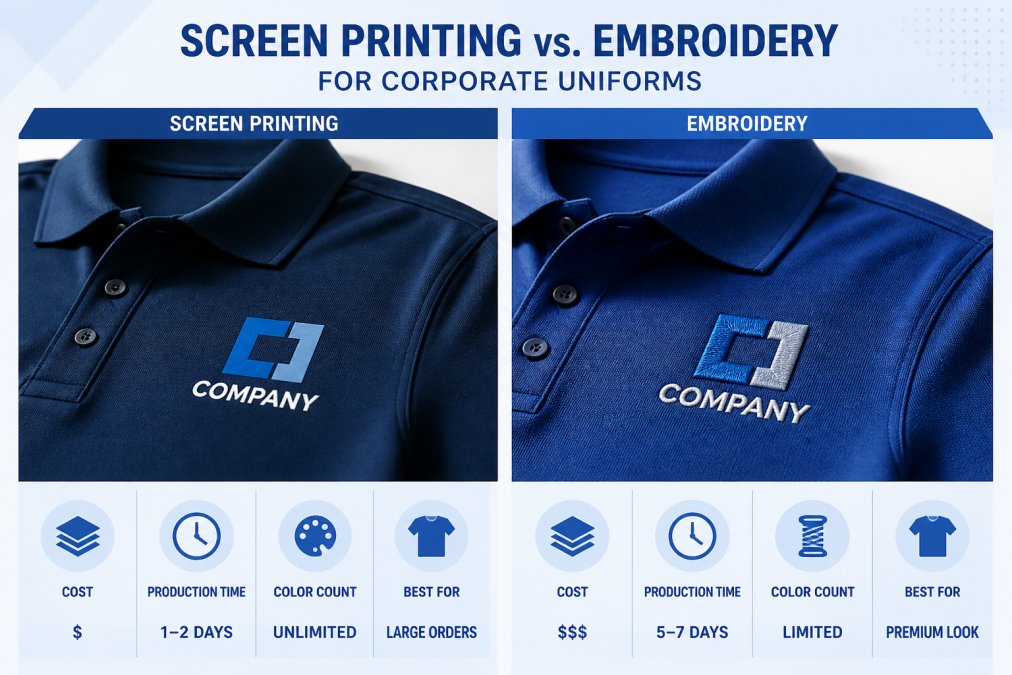
Screen Printing vs. Embroidery for Corporate Uniforms
Screen printing and embroidery serve different purposes. Neither is universally "better", the right choice depends on your design and priorities.
Screen printing works by pushing ink through a mesh screen onto fabric. It's cost-effective for large quantities and handles complex, multi-color designs efficiently. The print sits on the fabric surface, creating a smooth finish. Durability depends on ink quality and curing process. Professional screen printers use plastisol inks that withstand repeated washing when properly applied. The downside: setup costs are higher, making small orders expensive per unit.
Embroidery threads directly into fabric, creating a raised, three-dimensional effect. The result feels premium and conveys quality. Embroidery excels for logos with clean lines and solid colors. It handles minimalist designs beautifully. But embroidery struggles with fine detail, gradients, and photographic images. The per-unit cost remains relatively consistent regardless of order size, making small quantities more economical than screen printing.
Direct-to-garment (DTG) printing bridges the gap. It handles photographic detail and unlimited colors like screen printing, but without setup costs. Per-unit pricing remains higher than bulk screen printing, but small orders become feasible. For custom corporate apparel with complex designs, DTG offers flexibility that traditional methods can't match.
Quality Standards That Matter: Durability, Color Matching, and Print Longevity
Corporate uniforms represent your brand. Substandard quality damages perception and wastes budget when replacement becomes necessary within months.
Fabric weight and composition. Heavier fabrics (6-7 oz) feel more substantial and last longer than lightweight options (4-5 oz). Cotton blends offer durability and easier care compared to 100% cotton. Performance fabrics (polyester blends) resist wrinkles and maintain shape through repeated wear. For uniforms, 6 oz cotton-polyester blends typically deliver the best balance of durability, comfort, and maintenance.
Color matching accuracy. Pantone matching systems ensure consistency across orders. Ask vendors if they maintain color standards between production runs. Poor color matching creates visible inconsistency across your team, undermining the professional appearance uniforms are supposed to create. Request samples before committing to full orders, and specify pantone numbers rather than relying on color names.
Print durability testing. Professional vendors conduct wash testing to verify that prints withstand 20-50+ wash cycles without cracking, fading, or peeling. This matters more than most procurement teams realize. A print that looks perfect initially but degrades after five washes creates frustration and replacement costs. Ask vendors for wash-test documentation before ordering.
Supply chain transparency. Where do blanks come from? Are they ethically sourced? Do they meet durability standards? Reputable vendors can document their supply chain and provide certifications. This matters for corporate responsibility and risk management, counterfeit or substandard blanks create liability.
According to the American Apparel & Footwear Association, quality assurance standards for commercial apparel require testing for colorfastness, shrinkage, and seam strength. Vendors who follow these standards deliver predictable results.
Comparison Table: Key Factors for Corporate Apparel Selection
| Provider | Best For | Printing Methods | Minimum Order | Customization |
|---|---|---|---|---|
| Action Designs | Flexible needs, multiple techniques | Screen, Embroidery, DTG, DTF | Scalable | High |
| Lands' End Business | Premium branding, polished aesthetic | Embroidery, screen | Moderate | Moderate |
| ooShirts | Small teams, budget-conscious | Screen, DTG | None/Low | Moderate |
| Queensboro | Long-term partnerships, recurring orders | Screen, Embroidery | Moderate | Moderate |
| SendBetterSwag | Distributed teams, on-demand | DTG, embroidery | Per-unit | Moderate |
Conclusion
Switching corporate apparel providers feels risky when you've built a relationship with your current vendor. But the market has evolved. Businesses now have options that didn't exist five years ago, no-minimum orders, multiple printing techniques, on-demand inventory, and transparent quality standards.
The right provider depends on your specific situation. Small teams prioritize affordability and flexibility. Large organizations value consistency and account management. Teams with complex designs need vendors offering DTG or embroidery. Those focused on premium branding choose embroidery-first providers.
Action Designs delivers across all these dimensions. With screen printing, embroidery, DTG, and DTF capabilities in-house, we handle everything from simple single-color logos to intricate multi-color designs. Our scalable production means you're never forced into bulk commitments you don't need. Whether you're outfitting 10 employees or managing recurring orders for multiple locations, we adapt to your timeline and budget.
The Promotional Products Association International reports that businesses investing in quality branded apparel see measurable improvements in team cohesion and brand perception. That ROI depends on choosing the right partner.
Get a quote from Action Designs and see how our flexible printing techniques and transparent pricing compare to what you're currently paying. We'll walk you through your options and recommend the approach that makes sense for your team.
Frequently Asked Questions
What should I look for when choosing a custom corporate apparel provider?
Evaluate providers based on printing quality, turnaround time, minimum order requirements, and support for your design complexity. Ask about their experience with corporate uniforms, whether they offer sample kits, and how they handle color matching and revisions. Check if they provide transparency on fabric sourcing and durability testing. Request examples of previous corporate orders and confirm they can scale with your team's growth.
How do I know if a corporate uniform apparel provider's quality will actually last through regular washing?
Ask providers about wash testing protocols and how long their prints typically last. Screen printing and embroidery, when done properly, should withstand many commercial washes without significant fading or peeling. Request samples of garments they've printed and ask to see them after washing. Reputable providers will offer guarantees on print longevity and may provide case studies showing durability across different printing techniques.
Are there custom corporate apparel companies that work with small teams without huge minimum orders?
Yes. Several providers now offer no-minimum or low-minimum ordering options specifically for small businesses. These services are ideal for teams under 100 employees and allow you to order exactly what you need without excess inventory. Some even provide on-demand fulfillment, meaning you can distribute branded apparel to employees individually without holding bulk stock. Pricing per unit may be higher than bulk orders, but you avoid waste and storage costs.
What's the difference between screen printing and embroidery for corporate uniforms?
Screen printing works best for bold designs with fewer colors and is cost-effective for large quantities. It creates a smooth finish but may crack after repeated washing if not done properly. Embroidery is more durable and professional-looking, works well for logos and smaller designs, and lasts longer through washings. Embroidery costs more per unit but delivers superior longevity. For corporate uniforms with complex multi-color logos, direct-to-garment printing offers another option with excellent detail and durability.
This article was written using GrandRanker