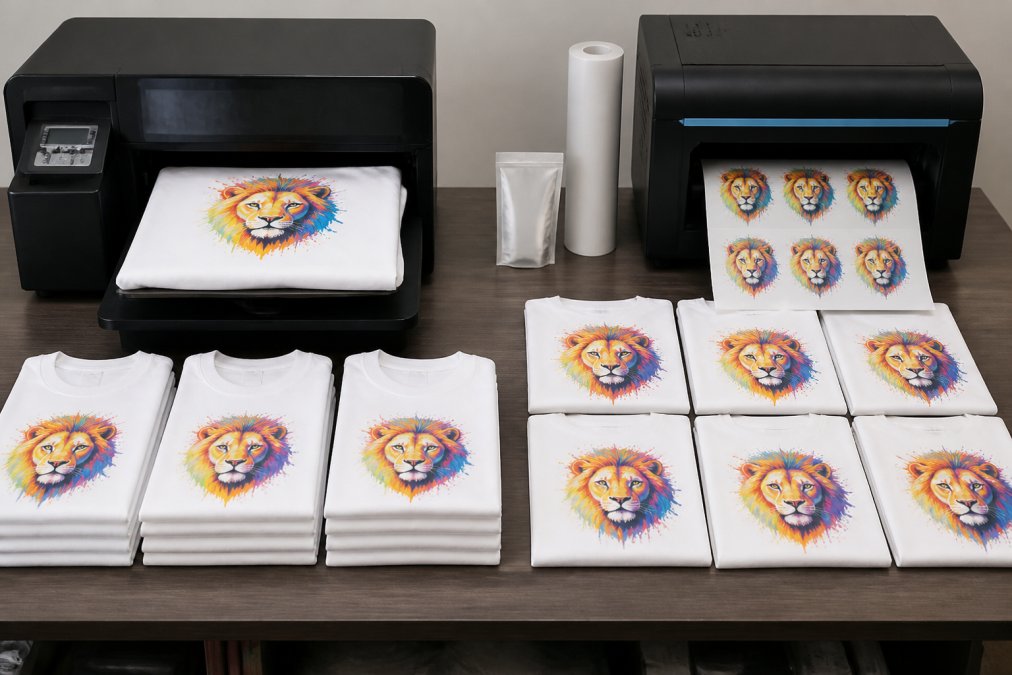
 comparison
DTG Printing vs DTF for Small Orders Cost: 2026 Guide
Table of Contents
- DTG vs DTF Cost Comparison at a Glance
- DTF Transfer Setup Costs vs DTG Equipment Investment
- Cost Per Shirt DTG vs DTF for Small Batches
- Durability of DTF Transfers vs DTG Prints After Washing
- Total Cost of Ownership: Hidden Maintenance and Waste Costs
- Fabric Compatibility and Cost by Garment Type
- Time-to-Profitability: Which Method Pays Back Faster
- Conclusion
- Frequently Asked Questions
Last Updated: September 11, 2026
DTG vs DTF Cost Comparison at a Glance
For small orders, dtg printing vs dtf for small orders cost usually favors DTF up front, because DTF lets you skip a large equipment purchase and pay per print instead. DTG jets water-based ink directly onto a garment; DTF prints a design onto transfer film, coats it with adhesive powder, and heat-presses it onto fabric. When you are weighing dtg printing vs dtf for small orders cost, the honest answer is that DTF wins on entry price and DTG wins on hand feel for all-cotton shirts. This guide breaks down setup costs, cost per shirt, wash durability, and payback time.
The table below summarizes the trade-offs before we dig into the numbers.
| Factor | DTG | DTF |
|---|---|---|
| Upfront equipment cost | High | Low to moderate |
| Best for | Small cotton runs, one-offs | Small runs across fabric types |
| Hand feel | Soft, ink-in-fabric | Slightly raised, film-based |
| Fabric range | Cotton-heavy | Cotton, polyester blends, more |
| Maintenance load | Daily, higher | Lower, periodic |
| Waste risk | Misprints on garment | Film and powder waste |
DTF Transfer Setup Costs vs DTG Equipment Investment
DTF transfer setup costs are dominated by the printer and the curing station, not the film itself. A compact desktop DTF printer typically runs in the low thousands of dollars, and still needs a heat press and a powder shaker or curing oven (shopify.com). DTG equipment investment is steeper: a professional machine is a contact-for-pricing unit in the mid-five-figure range, and needs pre-treatment equipment and a dedicated space with stable humidity.
The third option is to buy neither. Some services sell ready-to-press DTF transfers with no minimum order quantity, so you pay per print and press them yourself. That removes the equipment line entirely.
| Setup Path | What You Buy | Relative Cost | Best For |
|---|---|---|---|
| In-house DTG | Printer, pre-treatment, press | Highest | High-volume cotton shops |
| In-house DTF | Printer, powder, press, curing | Moderate | Shops wanting fabric range |
| Outsourced DTF | Heat press only | Lowest | Startups, event orders |
Cost Per Shirt DTG vs DTF for Small Batches
Cost per shirt DTG vs DTF flips depending on batch size. At very small quantities, DTF's per-print pricing and low setup keep unit cost predictable, while DTG's high equipment cost spreads across fewer garments. As batches grow into the hundreds, DTG's per-unit ink and labor costs fall and the gap narrows.
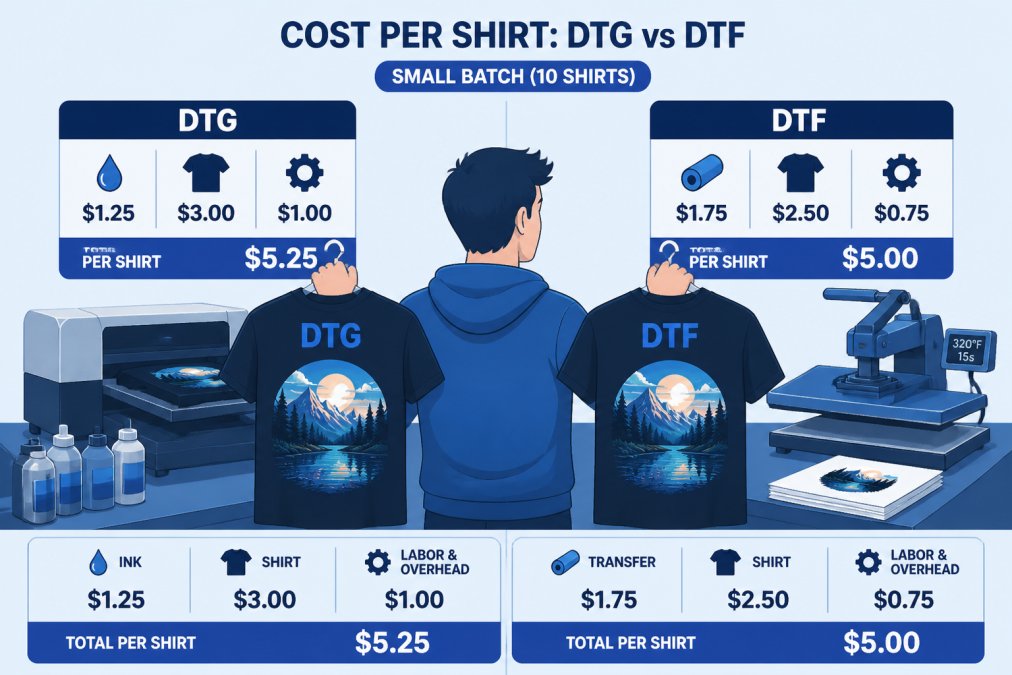
Ink consumption and waste drive the real difference. DTF consumes film, powder, and ink per transfer, and every misapplied transfer is wasted material. DTG consumes pre-treatment fluid and ink, and a misprint ruins the garment, which costs more than a ruined transfer.
Durability of DTF Transfers vs DTG Prints After Washing
Durability of DTF transfers vs DTG comes down to how each print bonds to the fabric. DTF transfers sit on top as a cured film, resisting cracking when fabric stretches but peeling at the edges if press temperature or pressure was wrong (stahls.com). DTG ink bonds into cotton fibers, fading gradually rather than peeling, and can look washed-out on dark shirts without a proper white ink base.
Both methods hold up well when curing is done correctly; failure points are almost always application errors, not the technology.
- Wash inside out in cold water to reduce abrasion
- Avoid high heat in the dryer, which stresses both films and inks
- Skip fabric softener, which leaves residue that weakens adhesion
- Check press temperature and pressure before every batch
Total Cost of Ownership: Hidden Maintenance and Waste Costs
Total cost of ownership is where most cost comparisons fall apart. The purchase price is visible, but maintenance cycles, electricity, ink consumption, and waste quietly decide whether a method is actually cheap. The line items below are the ones small operators feel in month two.
The hidden cost lines, itemized
| Cost Line | DTG | DTF |
|---|---|---|
| Routine maintenance kit | Printhead cleaning solution, capping station swabs, wiper blades, consumed weekly | Cleaning solution, powder shaker filters, roller wipes, consumed monthly |
| Daily startup ritual | Head clean cycle before first print; skipped cycles clog nozzles | No daily cycle required; periodic nozzle check on the film printer |
| Electricity draw | Printer, pre-treatment unit, and curing oven run continuously during a batch | Printer and powder shaker run during output; heat press draws in short bursts |
| Consumables per print | Pre-treatment fluid, white ink base, color ink | Film, adhesive powder, ink, plus transfer carrier |
| Waste per failure | A misprint ruins the garment, you eat the blank plus the ink | A botched transfer wastes film, powder, and ink, the garment is untouched |
| Depreciation | Mid-five-figure machine loses value faster and is harder to resell locally | Compact desktop unit holds a lower absolute dollar loss |
Why the waste asymmetry matters more than the ink price
The per-print consumable cost is usually close between the two methods. The difference that compounds is what a failed print costs you. On DTG, a nozzle clog discovered mid-batch ruins a garment that, on a dark shirt, already carries a pre-treatment layer and white ink base, the loss is the blank plus the full ink load plus labor. On DTF, a misfed or crooked transfer costs a sheet of film, a dusting of powder, and the ink on that sheet; the garment goes back in the stack.
For a small operator running 20 to 50 pieces at a time, that asymmetry is the biggest swing factor in real cost per sellable shirt: wasting three garments out of 50 on DTG loses more margin than wasting ten transfers out of 50 on DTF.
The maintenance time tax
DTG's daily maintenance is not just a supply cost, it is labor. A head clean cycle, nozzle check, and capping station wipe before every session adds up to real hours per month you are not printing. DTF's periodic cleaning is lighter, but the powder shaker and curing station still need scheduled filter changes and roller cleaning.
Price your own time at whatever you would pay someone to do it, and add that to the TCO. For a one-person shop, this is often the line item that flips the decision.
How to build your own TCO number
- List every consumable you will buy in a month (ink, pre-treatment, film, powder, cleaning solution, swabs, filters).
- Add your electricity estimate for a typical batch week.
- Add your maintenance time in hours multiplied by your hourly rate.
- Add expected waste: estimate your failure rate and multiply by the cost of a ruined garment (DTG) or a ruined transfer (DTF).
- Add monthly depreciation: purchase price divided by the number of months you expect to use the machine before replacing it.
The sum is your true monthly cost. Divide by the number of sellable shirts you produce in that month to get a real cost per shirt, the number that should drive your pricing, not the sticker price of the machine.
Fabric Compatibility and Cost by Garment Type
Substrate compatibility changes the math more than most buyers expect. DTG performs best on 100% cotton and cotton-heavy blends, and gets inconsistent on high-polyester garments (screenprinting.com). DTF adheres to a wider range, including polyester blends and synthetics, so one DTF setup covers more of your catalog.
That flexibility has a direct cost effect. If orders mix cotton tees with performance polos and hoodies, DTG may force you to outsource or decline the polyester pieces. DTF handles the whole run in-house, spreading setup cost across more jobs and improving margins per order.
| Garment Type | DTG Suitability | DTF Suitability |
|---|---|---|
| 100% cotton tees | Excellent | Very good |
| Cotton/poly blends | Good | Excellent |
| 100% polyester | Poor | Excellent |
| Hoodies and fleece | Good | Very good |
Time-to-Profitability: Which Method Pays Back Faster
Time-to-profitability is the clearest way to compare these methods, and it favors DTF for most small operators. Because DTF transfer setup costs are lower, you need fewer paid orders to recover your investment: a shop that outsources transfers and owns only a heat press can reach profitability on its first few jobs, while a shop that buys a DTG machine is betting on sustained volume.
The break-even formula
Break-even shirts = Total setup cost ÷ Profit per shirt
That is the whole calculation. The work is in getting honest numbers for both inputs.
Setup cost includes the machine, heat press, curing station or powder shaker, pre-treatment unit (DTG only), initial ink and consumable stock, and any dedicated space or ventilation.
Profit per shirt is selling price minus the blank garment, minus per-print consumable cost, minus labor time per shirt. Use profit, not revenue.
A worked framework you can plug your own numbers into
| Input | Outsourced DTF | In-House DTF | In-House DTG |
|---|---|---|---|
| Setup cost | Heat press only | Printer, press, shaker, curing, starter supplies | Printer, pre-treatment, press, curing, starter supplies |
| Per-shirt consumable | Per-print transfer price | Film, powder, ink | Pre-treatment, ink |
| Labor per shirt | Press time only | Press time plus output time | Pre-treatment plus print time |
| Break-even driver | Very low setup | Moderate setup | High setup |
Fill the setup cost and profit-per-shirt columns with your own figures and the break-even count falls out. The pattern across most small shops: outsourced DTF breaks even first, in-house DTF second, in-house DTG last.
Why DTG needs volume to justify itself
A DTG machine's cost is fixed and front-loaded, so every shirt spreads that fixed cost across one more unit. At 20 shirts the fixed cost per shirt is enormous; at 500 it is manageable. DTG economics only work with sustained volume, the machine does not get cheaper if you print less.
DTF inverts this: per-print cost is higher and more variable, but fixed cost is low, so you never carry a large sunk investment to amortize. For a shop that does not know its monthly volume yet, that is the safer structure.
The volume threshold where DTG catches up
There is a crossover point where DTG's lower per-unit consumable cost overtakes DTF's lower setup cost. It depends on your numbers, but the shape is consistent: the more shirts you print per month, the more DTG's per-unit advantage compounds and the faster the crossover arrives. Below that volume, DTF wins on payback speed; above it, DTG wins on long-run cost per shirt.
The decision rule for small operators
If you cannot confidently forecast the monthly shirt volume that makes DTG break even, do not buy the DTG machine. Start with outsourced DTF transfers and a heat press: you keep your capital, learn your real demand, and can buy the DTG machine later once volume justifies it. Buying the machine first and hoping volume shows up is the most expensive mistake in this category.
Conclusion
Choosing between these methods is really a question of volume and fabric mix, and getting it wrong is expensive. Action Designs offers DTG, DTF, screen printing, and embroidery, with the flexibility to supply garments or customize client-provided items. Our scalable production handles everything from single shirts to full collections, so you get professional branding. Get a quote from Action Designs and put the right printing method to work for your next order.
Frequently Asked Questions
Is DTG cheaper than DTF for small orders?
For orders under 50 shirts, DTF usually costs less per unit because you skip pre-treatment, white ink setup, and garment-specific pretreating. DTG has higher upfront costs for pretreating equipment and maintenance, which only pays off at higher volumes. If you outsource DTF transfers, you pay $3 to $5 per print with no equipment purchase, making DTF the lower-cost entry point for small batches.
How does DTF transfer setup cost compare to DTG equipment investment?
A desktop DTF printer runs approximately $3,000 to $5,000, plus a heat press and curing oven. A professional DTG printer typically starts at $14,000 or more. DTF also requires adhesive powder and transfer film, while DTG needs pre-treatment solution and specialized inks. For small operations, DTF setup costs are roughly one-third of DTG.
Which printing method offers better durability for the price?
DTF transfers generally hold up better across more wash cycles and fabric types than DTG, especially on polyester blends. DTG prints can fade or crack on 100% cotton after repeated washing if not properly cured. DTF transfers bond to the fabric with adhesive powder, creating a durable layer that resists cracking. For the price, DTF offers stronger wash durability per dollar on small runs.
What are the hidden costs of DTG vs. DTF printing?
DTG hidden costs include pre-treatment solution, frequent printhead cleaning, ink waste during maintenance cycles, and reprints from clogged nozzles. DTF hidden costs include adhesive powder, transfer film, curing equipment electricity, and shipping if you outsource transfers. Both methods have waste, but DTG maintenance cycles typically consume more ink and labor. Factor these into your cost per shirt DTG vs DTF calculation.
Is DTF more profitable than DTG for low-volume runs?
For runs under 100 units, DTF often delivers higher profit margins because the cost per print stays low and you can print multiple designs on one film sheet. DTG becomes more cost-effective at higher volumes where pre-treatment and ink costs spread across more shirts. If you outsource DTF transfers at $3 to $5 each and sell shirts at typical retail, margins can reach 50% or more on small orders.