 comparison
Embroidery Alternatives for Small Logos: 2026 Guide
Table of Contents
- Why Small Logos Break Embroidery (and What to Do Instead)
- Quick Comparison: Embroidery Alternatives for Small Logos
- DTF vs Embroidery for Small Logos
- Durability of DTF Transfers vs Embroidery
- Patches, Screen Printing, and Sublimation: Other Embroidery Alternatives
- DIY vs Professional Outsourcing for Small Logo Branding
- How to Choose the Right Method for Your Logo
- Conclusion
- Frequently Asked Questions
Last Updated: September 13, 2026
Why Small Logos Break Embroidery (and What to Do Instead)
Small logos break embroidery because needles, thread, and backing all have physical minimums that fine artwork ignores. A thread line occupies real space on a garment, and when a logo's details shrink below roughly 6 millimeters, letters fill in, counters close up, and thin strokes collapse into a blur. This guide from Action Designs covers the embroidery alternatives for small logos that actually hold their shape, and it explains where each one wins.
The core problem is structural, not a matter of finding a better embroidery shop. Stitch density has a floor: pack stitches too tightly and the fabric puckers; space them out and fine lines disintegrate. Thread tension compounds the issue, pulling lightweight fabric out of alignment around dense lettering. Fabric stability matters just as much, since a stretchy polo behaves nothing like a stiff canvas tote under the same stitch count.
Digitization makes it worse before it makes it better. Every logo must be converted into a stitch file, and that conversion forces trade-offs between detail and structural integrity. A vector file with crisp 2-point lines becomes a digitized pattern where those lines either merge or get simplified away.
That's the tension running through this entire article: embroidery is the most durable decoration method available, and it is also the worst one for very small, intricate artwork. The fix isn't better embroidery. It's choosing a different application method.
Below, we break down four embroidery alternatives, compare them on durability and detail, and show you how to pick the right one for your logo.
Quick Comparison: Embroidery Alternatives for Small Logos
The best embroidery alternatives for small logos are DTF transfers, custom patches, screen printing, and sublimation, each trading a different strength for the fine detail embroidery cannot hold. DTF and sublimation reproduce gradients and thin strokes; patches and screen printing hold up better over repeated washing.
Here's how the four options stack up before we go deep on each:
| Method | Detail Capability | Durability | Best For | Minimums |
|---|---|---|---|---|
| DTF transfer | Excellent, handles gradients | Good, watch crack resistance | Small runs, complex logos | None |
| Custom patches | Very good, consistent | Excellent | Texture and dimensional branding | Low |
| Screen printing | Good, crisp flat color | Very good | High-volume runs | Higher |
| Sublimation | Excellent, full color | Excellent on polyester | Light poly performance wear | Varies |
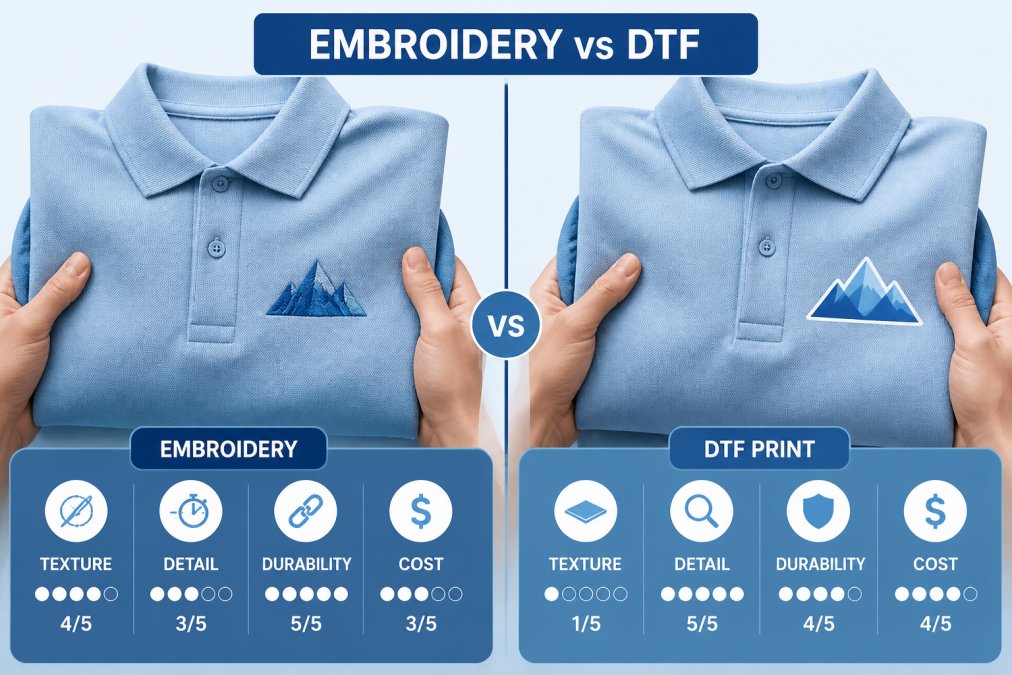
The pattern is clear: if your logo has fine lines or color blends, you move away from thread. If you need texture and a premium feel, patches beat direct stitching. If volume drives your budget, screen printing wins on cost-per-unit.
DTF vs Embroidery for Small Logos
DTF beats embroidery for small logos whenever the artwork contains fine lines, small text, or gradients. Direct-to-film printing lays down a full-color transfer with no stitch minimums, so a 3-color logo with 4-point type survives intact. Embroidery cannot match that at small scale, no matter how skilled the digitizer.
Where embroidery still wins is texture and perceived value. A stitched logo on a uniform reads as premium in a way a flat transfer does not. That's a real advantage for corporate apparel branding, and it's the reason many brands keep embroidery for large chest logos and switch to DTF for the small stuff.
Cost-per-unit also shifts with quantity. Embroidery setup is a one-time digitizing charge that amortizes across the run, so it gets cheaper per unit as volume climbs. DTF has minimal setup, which makes it the better call for short runs and single items.
How DTF Handles Fine Lines and Gradients
DTF handles fine lines and gradients by printing the artwork at high resolution onto a film, then transferring the whole image to the garment in one press. There is no needle to fill in a letter's counter and no thread count limit on how thin a line can be.
That capability matters most for modern brand marks. Intricate details, drop shadows, and multi-color blends all transfer cleanly. Color matching is also more predictable than thread matching, because you're working from a digital color profile rather than a finite thread palette.
The trade-off is feel. A DTF transfer sits on top of the fabric as a thin film, so it adds a slight texture that embroidery doesn't. On a heavyweight tee, most people never notice. On a lightweight performance shirt, it's more apparent.
Durability of DTF Transfers vs Embroidery
Embroidery outlasts DTF in most head-to-head durability comparisons, because thread is stitched through the fabric while a transfer bonds to its surface. A well-digitized embroidered logo can survive years of industrial laundering. A DTF transfer typically holds up through dozens of wash cycles before showing wear, depending on the garment and care (aatcc.org).
That gap narrows considerably with proper application. Transfer temperature, pressure, and dwell time determine how well the film bonds, and a poorly pressed transfer fails early regardless of the technology's potential (stahls.com). This is where production workflow discipline separates good suppliers from cheap ones.
For uniforms that get washed constantly, embroidery on the large logo and a patch or transfer on the small one is a common compromise. You get durability where it matters most and detail where thread can't deliver.
Wash Fastness and Crack Resistance
Wash fastness and crack resistance both come down to the bond between transfer and fabric, plus how the garment is laundered. Cracking usually starts at the edges of a design, where the film flexes most during wear and washing.
A few practices extend transfer life considerably:
- Wash garments inside out in cold water
- Avoid high-heat drying, which stresses the bond
- Skip fabric softener, which can degrade the adhesive layer
- Never iron directly over a transfer
Embroidery has no adhesive layer to fail, so it sidesteps these issues entirely. That's the honest trade-off: transfers win on detail, thread wins on longevity.
Patches, Screen Printing, and Sublimation: Other Embroidery Alternatives
Patches, screen printing, and sublimation round out the options, and each solves the small-logo problem differently. Custom patches deliver texture and dimensional branding without stitch minimums. Screen printing handles high-volume runs cheaply. Sublimation dyes the fabric itself for a finish that never cracks.
Start with patches when you want the premium look of embroidery without its detail limits. A woven or embroidered patch is produced separately, then applied by heat press or sewing. Because the patch is made off-garment, the fine details can be controlled precisely, and the result looks identical across different fabric types. The drawback is cost: patches carry a higher per-unit price than simple embroidery and require a secondary application step.
Screen printing is the volume play. It reproduces crisp logo edges in flat color and gets cheaper per unit as quantities rise, which is why it dominates large orders of branded apparel. The catch is setup cost, which makes small batches expensive, and the flat finish, which lacks the tactile quality some brands want.
Sublimation is the specialist. It infuses dye into the fabric, so the logo becomes part of the garment with no added weight and no cracking. The limitation is fabric: sublimation only works well on light-colored, high-polyester garments, which rules out cotton-heavy options.
Custom Patches for Texture and Consistency
Custom patches solve the consistency problem that plagues direct embroidery on varied garments. Because the patch is manufactured to spec, the same logo looks the same on a structured jacket and a soft hoodie. Direct stitching on those two fabrics can produce noticeably different results.
Choose patches when your brand leans on texture and dimensional presence, and when you need one logo to work across a mixed uniform program. The secondary application step is a genuine cost and logistics factor, so factor it into your timeline.
Screen Printing and Sublimation for High-Volume Runs
Screen printing wins when quantity is high and the design uses solid colors. Sublimation wins when the garment is polyester and the design is full-color. Both beat embroidery on cost-per-unit at scale, and both handle small logo dimensions that thread cannot.
If your logo has seven colors and you need a few hundred shirts, screen printing and DTF are usually the practical answers, not embroidery. Setup charges spread across the run, and the per-unit cost drops accordingly.
DIY vs Professional Outsourcing for Small Logo Branding
Professional outsourcing usually beats DIY for small-logo branding, because the equipment and expertise required to get fine detail right are hard to justify for occasional orders. A heat press, a quality printer, and the skill to dial in temperature and pressure are a real investment.
DIY makes sense in narrow cases. If you decorate a handful of items a month and your designs are simple, a home setup can work. The moment you need consistent color matching, reliable wash fastness, or any real volume, the math flips toward a professional shop.
What most guides miss is the revision overhead. Back-and-forth on design files can consume hours, and a supplier with a clean production workflow and clear proofing process saves that time. When you evaluate a vendor, ask how they handle digitization or file prep, how they proof color before a full run, and what their process looks like from approval to delivery.
How to Choose the Right Method for Your Logo
Choosing the right method comes down to four variables: logo complexity, order quantity, garment fabric, and how often the item gets washed. Match those against each method's strengths and the decision usually makes itself.
Work through it in this order:
- Assess logo complexity. Fine lines, small text, or gradients? Rule out direct embroidery.
- Count your quantity. Under a few dozen units, favor DTF or patches. Hundreds or more, screen printing gets competitive.
- Check your fabric. Light polyester points to sublimation. Cotton and blends favor DTF, screen printing, or patches.
- Weigh wash frequency. Daily-wear uniforms favor patches and embroidery. Occasional event apparel can use transfers.
- Confirm color expectations. If exact brand color matters, ask how each method handles color matching before you commit.
A supplier that offers multiple decoration methods can match the technique to the job instead of forcing one process onto every order. Action Designs, for example, works across screen printing, embroidery, DTG, and DTF, and can either supply garments or customize items you provide, which removes the guesswork of splitting a project across vendors.
That flexibility matters most when your logo program includes both large and small marks. You can embroider the big chest logo for durability and use DTF or a patch for the small sleeve mark, all through one production workflow.
Conclusion
Small logos expose the limits of embroidery, and pretending otherwise wastes money on runs that come back looking muddy. The fix is matching the method to the mark: DTF for fine detail, patches for texture, screen printing for volume, and sublimation for polyester performance wear. Get that match right and your small logo finally looks the way you designed it.
Frequently Asked Questions
What are the best embroidery alternatives for small, detailed logos?
For small, detailed logos, DTF printing and custom patches are the strongest alternatives. DTF handles fine lines, gradients, and small text without the thread density issues that cause embroidery to blur or pucker. Custom patches work well when you want a dimensional look and consistent detail across different fabric types. Screen printing also works for simple, high-contrast logos at volume.
Is DTF printing better than embroidery for small text?
DTF printing typically reproduces small text more accurately than embroidery. Embroidery requires a minimum letter height of about 0.25 inches to stay legible, and thread density can close up gaps in fine fonts. DTF prints at high resolution, so text as small as 6-point remains sharp. For logos with taglines or fine print, DTF is the more reliable choice.
How does the durability of DTF transfers compare to embroidery?
Embroidery is mechanically locked into the fabric, so it outlasts almost any print method over decades of washing. DTF transfers bond to the garment surface and hold up well for 50 or more washes when applied correctly. After that, edges may begin to lift or crack. For uniforms washed daily, embroidery still wins on longevity; for promotional apparel washed occasionally, DTF performs well.
Can heat transfers provide the same durability as embroidery?
Heat transfers, including DTF, cannot match embroidery's lifespan. Embroidery stitches are woven into the fabric and will not peel or fade. Heat transfers rely on a adhesive bond that can weaken with repeated high-heat washing or friction. Using cold-water washes and turning garments inside out extends transfer life significantly, but embroidery remains the more durable option for daily-wear uniforms.
What is the most cost-effective way to brand small logos on apparel?
For large orders of simple logos, screen printing delivers the lowest cost per unit once setup is complete. For small batches or complex logos with many colors, DTF avoids setup fees and minimums, making it more affordable. Embroidery setup includes digitizing, which adds upfront cost. Pricing depends on quantity, artwork complexity, and turnaround, so request a quote for exact figures.
If your current supplier keeps forcing embroidery onto artwork it can't handle, Action Designs offers screen printing, embroidery, DTG, and DTF under one roof, with the ability to supply garments or customize items you already own. Scalable production means the same quality whether you need a single shirt or a full collection. Get a quote from Action Designs and see your small logo reproduced with the precision it deserves.