 how-to
How to Order Small Batch Custom Apparel
Table of Contents
- Choose Your Garment Style and Supplier
- How to Prepare Artwork for Custom Apparel
- DTG vs Screen Printing for Small Orders
- Upload Your Design and Select Quantities
- Custom Apparel Printing Turnaround Time and Shipping
- Understanding Pricing for Small Batch Orders
- Place Your Order and Track Delivery
Last Updated: August 30, 2026
Choose Your Garment Style and Supplier
Ordering small batch custom apparel starts with two decisions: what garment type you need and who will produce it. This choice determines your design options, printing method, timeline, and cost per unit.
Different garments, t-shirts, hoodies, polo shirts, tank tops, hats, jackets, have different fabric weights and printing compatibility. A lightweight cotton tee behaves differently under screen printing than a performance polyester blend. When ordering small batches, discovering incompatibility after production starts is costly.
Look for suppliers specializing in low-minimum orders. Traditional screen printers often require 50-unit minimums, eliminating them for true small batch work. Modern suppliers using direct-to-garment (DTG) and heat transfer printing allow orders as small as one unit.
At Action Designs, we work with businesses and individuals at every scale, from single custom shirts to full collections. Our approach matches the right printing technique to your order size and design complexity. We supply garments or customize items you provide, giving you flexibility.
When evaluating suppliers, ask about turnaround times, quality guarantees, and revision policies. A supplier offering unlimited design revisions saves hours of back-and-forth communication.
How to Prepare Artwork for Custom Apparel
Your design file bridges your vision and the finished product. Poor file preparation is a common reason small batch orders disappoint.
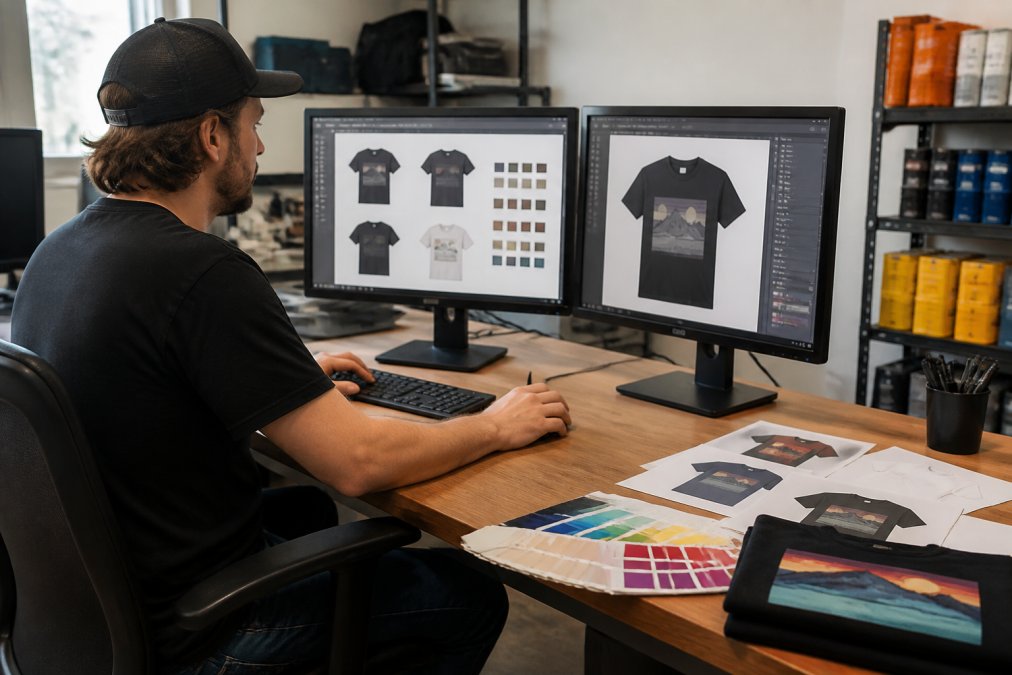
File format matters significantly. Most suppliers accept vector files (AI, EPS, PDF) and raster files (PNG, JPG, TIFF). Vector graphics, created in Adobe Illustrator, scale infinitely without quality loss and are ideal for logos, text, and solid-color designs. Raster files are pixel-based and work best for photographs or detailed artwork.
For small batch orders, vector files are preferable. They compress cleanly, scale without pixelation, and print with sharp edges. If your design includes photography, a high-resolution raster file (300 DPI minimum) works, and combining vector elements with raster photography is acceptable.
Submit files in RGB or CMYK depending on your supplier's requirements. RGB is standard for digital displays; CMYK is the print standard. Clarify this before finalizing artwork, as a vibrant screen design might print differently if color space isn't aligned.
Resolution and DPI affect print quality directly. For screen printing and DTG, 300 DPI at final print size is standard. Submitting 72 DPI web graphics results in blurry, pixelated output.
Design placement requires attention. Most suppliers provide templates showing safe zones for printing. Avoid placing critical elements too close to seams or edges. Request a digital proof before production to test placement.
Color matching is critical. Your monitor displays colors differently than fabric will. Request color samples from your supplier showing how your chosen colors appear on the specific garment. A blue that looks perfect on screen might shift noticeably on fabric.
DTG vs Screen Printing for Small Orders
Choosing between direct-to-garment (DTG) printing and screen printing is critical when ordering small batch custom apparel. Each method has distinct advantages and cost structures that change based on order size and design complexity.
Direct-to-garment printing works like an inkjet printer for fabric. The printer applies water-based or plastisol ink directly onto the garment. DTG excels at photographic designs, full-color artwork, and complex color gradients. There's no setup fee, no color separation required, and no minimum order quantity. Per-unit cost is identical whether you order one or one hundred shirts.
Screen printing involves creating a mesh screen for each color in your design. Ink is pushed through the screen onto the garment. Setup costs $25-$75 per color depending on the supplier. Once screens are ready, per-unit printing cost drops significantly. Screen printing produces vibrant, durable prints that withstand hundreds of washes.
For small batch custom apparel, DTG typically costs less per unit when ordering fewer than 50 pieces. There's no setup fee, so cost is purely per-garment printing. Screen printing's setup fees make sense only when per-unit savings offset that initial investment. At 25 units, screen printing setup might add $3-$5 per shirt. At 100 units, that overhead drops to 25-50 cents per shirt.
Design complexity drives the choice. A full-color photographic design is impossible with screen printing without prohibitive costs. DTG handles unlimited colors without additional cost. A simple single-color logo prints more economically via screen printing once you reach 50+ units.
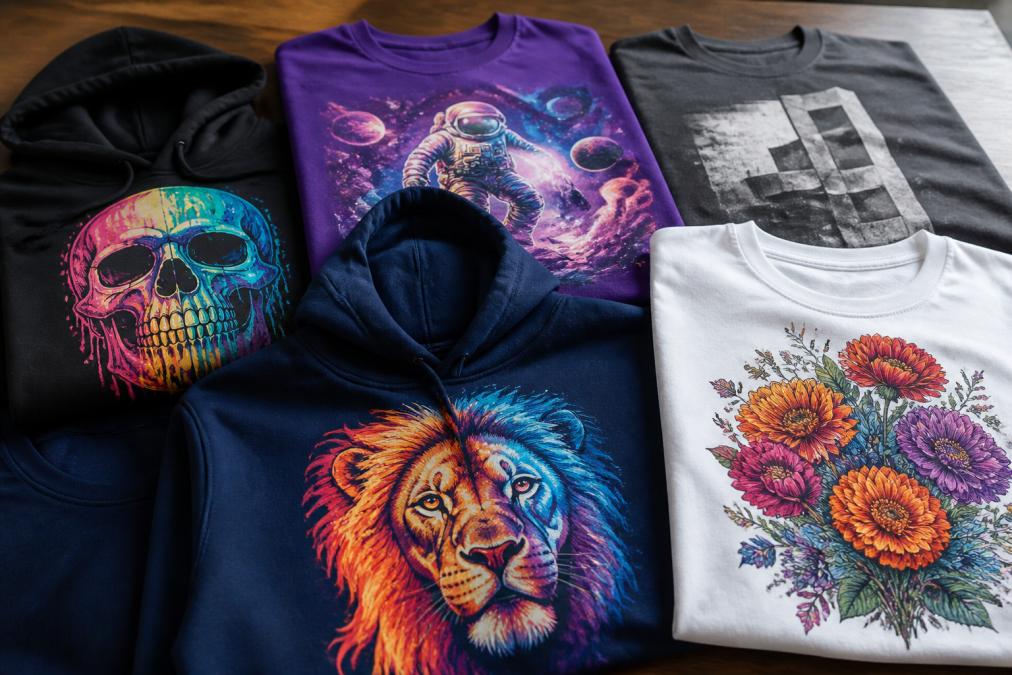
Durability differs between methods. Screen-printed designs last longer under repeated washing because ink bonds with fabric fibers. DTG prints are durable with proper care but may show slight fading after 50+ washes (peer-reviewed research). For merchandise worn frequently, screen printing's longevity justifies higher upfront cost.
Print quality varies by method and supplier. Screen printing produces flat, consistent color and sharp edges on simple designs. DTG produces photorealistic quality and smooth color gradients. For designs with fine details or subtle shading, DTG delivers superior results.
DTG typically offers faster turnaround, often 5-7 business days from file approval to shipment. Screen printing requires screen preparation, adding 3-5 days. For rush orders, DTG is advantageous.
Consider your specific needs: order quantity, design complexity, durability requirements, and timeline. For small batch orders under 50 units with complex designs, DTG usually wins. For larger batches with simple, bold designs, screen printing becomes competitive.
Upload Your Design and Select Quantities
Once you've prepared your artwork and chosen a printing method, the ordering process is straightforward. Most suppliers provide online platforms where you upload your design, select garment styles and colors, and specify quantities for each size.
The upload interface varies by supplier but follows a consistent pattern. You'll drag and drop your file or click to browse. The system validates file format and resolution, providing instant feedback on acceptability. This validation catches problems before they reach production.
After uploading, select your garment: the specific item, color, and size range. Most suppliers show color swatches. Request color samples if uncertain; ordering the wrong color is an expensive mistake.
Quantity selection requires thinking through actual needs. Be realistic about what you'll distribute or sell. For a team of 20 people, you might order 4 small, 6 medium, 7 large, and 3 extra-large. Request guidance from your supplier on typical size distributions if unsure.
Design placement is typically selected during ordering. You'll choose front print, back print, or both. Some suppliers allow sleeve prints or side placement for an additional fee. Confirm what's included in your quoted price.
Custom Apparel Printing Turnaround Time and Shipping
Understanding turnaround time and shipping logistics prevents frustration and missed deadlines.
Turnaround time is the period from design approval to shipment. For small batch custom apparel, this typically ranges from 5-14 business days depending on printing method and supplier capacity.
DTG printing offers faster turnaround, usually 5-7 business days, because there's no setup phase. Screen printing requires 3-5 additional days for screen preparation, pushing typical turnaround to 8-12 business days. Rush options exist but often cost significantly more per unit.
Order complexity affects timing. A single design on one garment style ships faster than five designs across multiple garment types. Supplier capacity during busy seasons impacts turnaround; peak seasons can extend timelines by 5-10 days. Communicate firm deadlines upfront.
Shipping logistics begin once production finishes. Most suppliers use USPS, UPS, or FedEx. Standard shipping typically takes 3-7 business days depending on destination distance (usps.com). Expedited shipping costs more but arrives in 1-3 business days.
Shipping cost depends on package weight, dimensions, and destination. A box of 50 t-shirts weighs roughly 15-20 pounds and costs $20-$50 to ship domestically. Some suppliers offer local pickup, eliminating shipping costs entirely.
Reputable suppliers provide tracking numbers and status updates. You should receive notification when production starts, completes, and when the package ships. Action Designs can discuss shipping and delivery options tailored to your specific location and timeline needs.
Understanding Pricing for Small Batch Orders
Pricing for small batch custom apparel varies based on several factors. Understanding cost drivers helps you budget accurately and identify fair pricing.
Per-unit cost is the primary metric: total project cost divided by the number of garments. A 50-shirt order costing $500 total equals $10 per shirt. A 500-shirt order costing $3,000 total equals $6 per shirt. Larger quantities reduce per-unit cost through economies of scale.
Small batch orders operate differently. When ordering 25 or 50 units, total project cost matters more than per-unit rates. Pricing might be "25-50 units: $300-$600 depending on garment and design complexity."
Garment cost is the foundation. Blank t-shirts range from $3-$8 depending on quality and material. Premium blanks cost more but feel and last longer. For small batch orders where durability matters, investing in better blanks is worthwhile.
Printing cost depends on method and design. DTG printing typically costs $3-$8 per garment depending on coverage area and color complexity. Screen printing costs $2-$5 per garment after accounting for setup fees. For 25 units with screen printing, the setup fee ($50-$150) adds $2-$6 per shirt. At 100 units, that overhead drops to 50 cents per shirt.
Design placement affects cost. Front-only prints cost less than front-and-back prints. Sleeve prints or specialty placements add $1-$3 per garment.
Customization options add cost. Embroidery costs $1-$5 per garment depending on design complexity. Heat transfer printing falls between DTG and screen printing in cost. Specialty inks add $1-$2 per garment.
Quantity breaks provide savings. Most suppliers offer tiered pricing: 25-50 units at one rate, 51-100 at a lower rate, 101-250 at an even lower rate. Understanding these tiers helps you decide whether ordering slightly more units makes financial sense.
Rush fees apply when you need faster turnaround. Expedited production typically costs 20-50% more. If your timeline is flexible, standard turnaround offers better value.
Shipping cost is separate from garment and printing cost. Budget $25-$75 for standard domestic shipping on small batch orders.
A sample order of 50 blank t-shirts with DTG printing might cost: garments ($250), printing ($300), and shipping ($40) equals $590 total, or $11.80 per shirt. Request detailed quotes showing each cost component. Action Designs provides itemized quotes showing garment cost, printing cost, and shipping separately.
Place Your Order and Track Delivery
Before clicking "place order," review every detail. Confirm garment type, color, and size quantities match your needs. Verify your design file is the correct version. Check that the quoted price matches your budget and includes all selected options. Most suppliers allow edits until you pay.
Payment methods vary by supplier. Most accept credit cards, PayPal, and bank transfers. Some require a deposit (typically 50%) to start production, with the balance due before shipping. Understand the payment terms before ordering.
Once you've paid, you'll receive an order confirmation email with your order number and estimated delivery date. Save this email for reference.
Production begins immediately after payment clears. You should receive notification when your order enters production, typically within 1-2 business days. This is your final opportunity to request changes. After production starts, modifications become difficult or impossible without significant cost.
During production, you can request a progress update. Quality suppliers will send photos of your finished apparel before shipping, allowing you to confirm everything looks correct. Catching issues before shipment is critical.
Once production finishes, you'll receive tracking information. This tracking number lets you monitor your package's journey from the supplier's facility to your location.
Upon delivery, inspect your order immediately. Check that quantities match, garments are the correct size and color, and prints are clean and properly positioned. If you notice defects, contact the supplier within 48 hours of delivery. Most reputable suppliers stand behind their work and will reprint or reship orders with genuine issues.
Ordering small batch custom apparel doesn't require industry expertise. What it requires is understanding key decisions, garment selection, printing method, artwork preparation, and supplier choice, and executing them thoughtfully. The suppliers you choose, the designs you prepare, and the attention you pay to details determine whether your small batch order succeeds.
When you're ready to move forward with small batch custom apparel, Action Designs can guide you through every step. We work with businesses of all sizes, from single custom shirts to full collections. Our team handles garment sourcing, multiple printing techniques including screen printing, DTG, embroidery, and heat transfer, and design consultation to ensure your vision translates to finished apparel. Get a quote today and see how we can bring your custom apparel project to life.
Frequently Asked Questions
Can I order just one custom shirt without a minimum order requirement?
Yes. Many small batch custom apparel providers now offer no-minimum orders, allowing you to order a single shirt or a handful of pieces. This flexibility works well for personal projects, gifts, or testing designs before committing to larger quantities. Pricing per unit will be higher on single orders than bulk runs, but the ability to start small eliminates upfront risk and waste.
What's the difference between DTG and screen printing for small orders?
DTG (direct-to-garment) printing works best for small batches with complex, multi-color designs and intricate details. It requires no setup fees and handles photo-quality images well. Screen printing is more economical for simple designs with 1-4 colors and becomes cheaper per unit as quantities grow, but involves setup costs that don't justify small orders. For batches under 50 pieces, DTG typically delivers better value and faster turnaround.
How do I prepare my artwork files for custom apparel printing?
Use vector graphics (AI, EPS, or PDF files) for best results, they scale without losing quality. For DTG, high-resolution raster files (300 DPI) work if vectors aren't available. Ensure your design accounts for garment placement and size; provide color specifications in CMYK or Pantone. Remove backgrounds, check file dimensions against garment mockups, and confirm that fine details won't blur during printing. Ask your provider for specific file requirements before uploading.
How long does it take to receive small batch custom apparel?
Turnaround depends on the printing method and order complexity. DTG printing typically ships within 5-10 business days from order confirmation. Screen printing may take 7-14 days due to setup time. Shipping adds another 2-7 business days depending on your location and carrier. Rush options are available but cost more. Confirm timelines with your provider upfront, especially for events or deadlines.
This article was written using GrandRanker