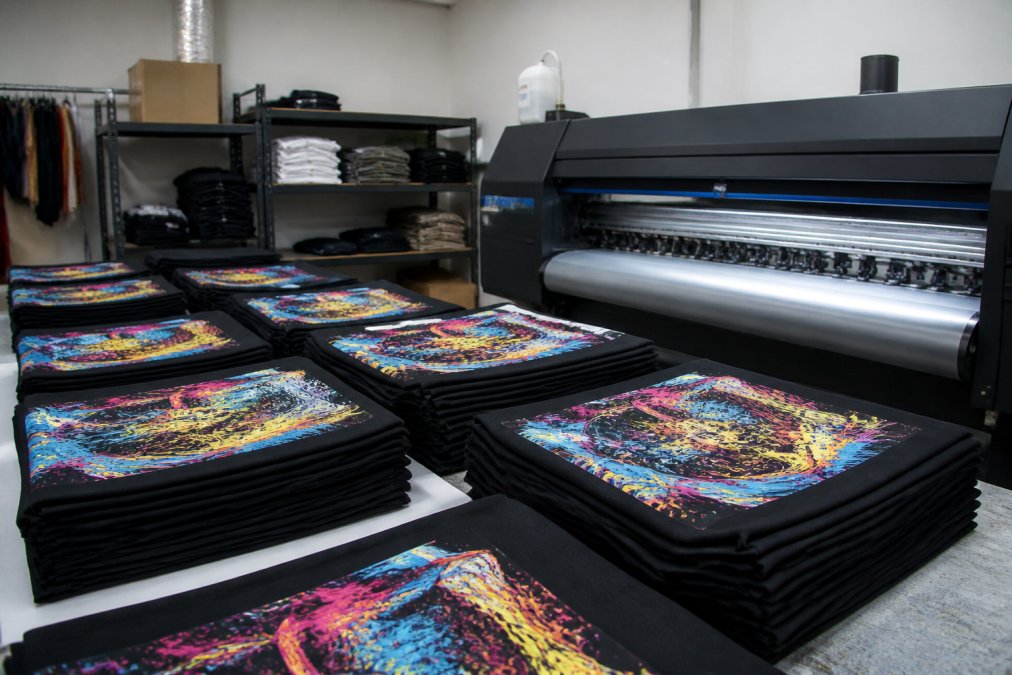
 how-to
How Long Does DTF Printing Take for Large Orders?
Table of Contents
- Typical Turnaround Times for Large DTF Orders
- DTF vs Screen Printing Speed: Which Wins for Bulk?
- Factors Affecting DTF Printing Time
- How to Speed Up DTF Production Without Cutting Corners
- Printing Time vs. Shipping Time: What Actually Delays Your Order
- Cost-Benefit Analysis: Is a Rush DTF Order Worth It?
- Frequently Asked Questions
Last Updated: September 16, 2026
Typical Turnaround Times for Large DTF Orders
Large DTF orders typically ship within 5 to 10 business days, though that window shifts with order volume, gang sheet layout, and print queue position. This guide from Action Designs breaks down what drives dtf printing timelines so you can plan a launch, trade show, or uniform rollout without guessing.
Direct to film printing prints designs onto PET film, coats them with adhesive powder, cures the ink, then heat-presses the transfer onto a garment. For large orders, the bottleneck rarely sits where buyers assume.
Standard Production Windows by Order Size
Production time scales with quantity, but not linearly. Setup, file prep, and curing are largely fixed costs, so per-unit time drops as volume climbs.
| Order Size | Typical Production Window | Notes |
|---|---|---|
| 1-25 pieces | 1-3 business days | Often batched with other jobs |
| 26-100 pieces | 3-5 business days | Gang sheet efficiency kicks in |
| 101-500 pieces | 5-8 business days | Queue position matters most here |
| 500+ pieces | 7-12 business days | Split into multiple print runs |
Those ranges assume clean artwork and standard garment colors. Add a week if your files need rebuilding or your blanks are backordered.
Rush Service Options and Cut-Off Times
Rush production compresses the print window, not physics. Most shops offer rush tiers that cut two to four business days off standard turnaround, provided you hit the order cut-off (usually early afternoon) and your files are print-ready on arrival.
Rush fees buy queue priority, not faster curing. If your design needs a powder shaker pass and a full cure cycle, that time is fixed no matter what you pay.
DTF vs Screen Printing Speed: Which Wins for Bulk?
Screen printing wins for large single-design runs; DTF wins for complex, multi-color, or variable designs at moderate volumes. The crossover point usually lands between 100 and 300 pieces, driven mostly by color count.
When Screen Printing Pulls Ahead
Screen printing requires a separate screen per color. Setup is expensive and slow up front, but once screens are burned, presses run fast and cheap per unit. For a one-color logo on 1,000 shirts, screen printing almost always beats DTF on cost and throughput.
The math flips the moment you add colors. Seven colors means seven screens, seven setup charges, and a much longer press run.
When DTF Is the Faster Choice
DTF skips screens entirely. A seven-color design prints in a single pass, making it faster to set up and more flexible for small and mid-size runs. It also handles fine detail, gradients, and photographic elements that screen printing struggles to reproduce cleanly.
For teams ordering 50 to 300 pieces with detailed artwork, DTF is usually the faster route from file to finished garment. Action Designs specializes in versatile printing techniques like screen printing, embroidery, DTG, and DTF, so recommendations come from what fits your job rather than what the shop prefers to sell.
Factors Affecting DTF Printing Time
Three variables dominate: design complexity, gang sheet layout, and print queue position. Understanding the mechanics behind them lets you predict your own timeline instead of accepting a vendor's estimate on faith.
Design Complexity and File Preparation
Simple vector logos print fast. Complex artwork with fine lines, gradients, or heavy detail requires higher resolution settings, slowing the printer and raising reprint risk. File prep is the hidden time sink: a vector file with proper cut lines moves straight to print, while a low-resolution JPEG with a white background must be rebuilt first, adding a day or more.
DTF printers lay down white ink as an underbase, then CMYK, then a final white layer. Every extra ink pass slows the carriage and adds drying time. A design with heavy white coverage, a large solid logo on a dark garment, takes meaningfully longer per transfer than light line art of the same size. That's why two 200-piece orders can have different production windows at the same shop.
Gang Sheet Layout and Print Queue Position
A gang sheet is a single film with multiple designs nested together to minimize wasted material. Good nesting means more transfers per run and faster throughput; poor nesting, or dozens of separate small files, forces the operator to build the sheet manually.
Film width drives nesting decisions. Standard DTF film comes in 13-inch, 17-inch, and 24-inch rolls, and a shop running 13-inch film can only fit so many transfers across before starting a new row. Artwork sized to leave dead space on every row wastes film and adds rows. Sizing transfers to fit the film width cleanly is one of the few levers a buyer controls.
Queue position is the other lever. Printers run jobs in sequence, so a 500-piece order behind three other large jobs waits its turn.
Equipment Throughput: Printer, Shaker, and Oven
- Printer, measured in linear feet of film per hour. A single-head printer and a dual-head printer can differ by a wide margin on the same design.
- Powder shaker, applies adhesive powder and shakes off the excess. This stage is often the real bottleneck on bulk runs because it is a manual or semi-manual feed on many shop floors.
- Curing oven, runs at a fixed temperature and belt speed. You cannot speed up the belt without under-curing the ink, so oven throughput is effectively fixed per shop.
How to Speed Up DTF Production Without Cutting Corners
The fastest way to speed up DTF production is to eliminate rework, not shave corners on curing or print resolution.
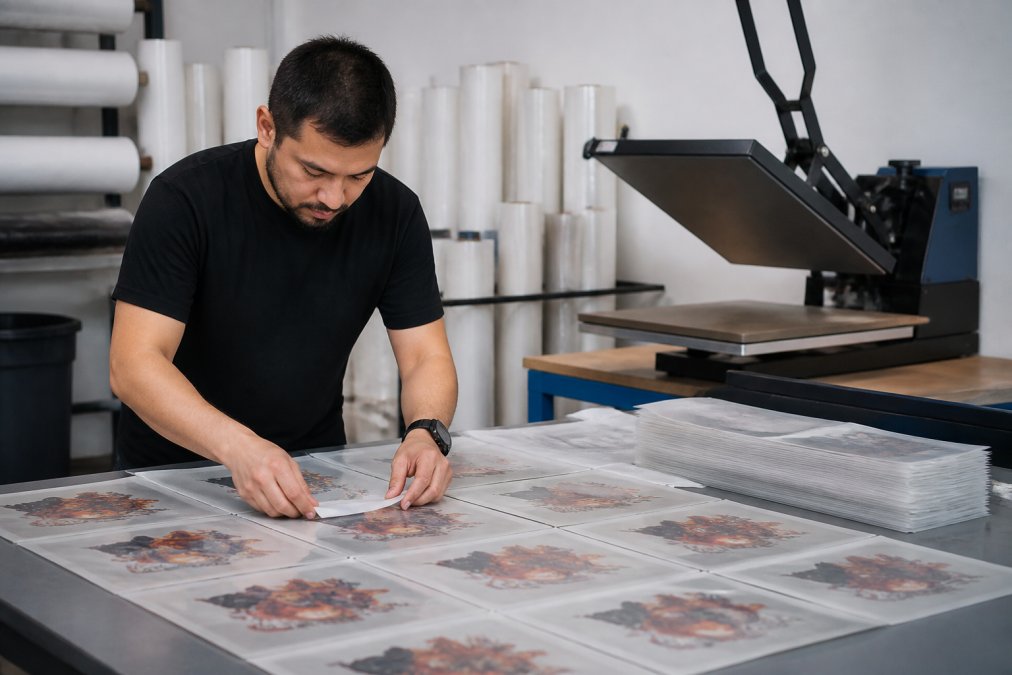
Workflow Optimization for Small Shops
- Standardize a file intake checklist (vector format, transparent background, correct dimensions)
- Batch similar jobs into one gang sheet instead of running them separately
- Pre-stage garments by size and color before the press starts
- Track actual cure times per film type and post them at the press
- Set a firm daily cut-off and hold everything after it for the next run
Quality vs. Speed Trade-Offs
- Under-cured ink, the print looks fine coming off the press and fails after a few washes. This is the most common rush-order failure and the hardest to catch visually.
- Uneven powder distribution, shows up as patchy adhesion, usually at the edges of a transfer. More likely when a shaker is run at high speed to keep up with a fast printer.
- Color shift from over-fast curing, running the oven belt faster than the ink's cure curve allows can shift colors, especially in reds and oranges, because the pigments do not fully set.
Identify Your Real Bottleneck Before You Optimize
- Time the printer. How long does a full gang sheet take from start to finish?
- Time the shaker. How long does that same sheet take to powder and shake?
- Time the oven. How long is the sheet in the cure tunnel?
- Compare the three. The slowest stage is your bottleneck. Everything else is downstream noise.
Printing Time vs. Shipping Time: What Actually Delays Your Order
Shipping time is separate from production time, and confusing the two is why deadlines get missed.
Shipping Transit Estimates and Logistics
Ground transit across the continental U.S. generally runs three to five business days; expedited air cuts that to one or two.
Real-World Bottleneck Identification
Trace any late order and you'll find one of four culprits: artwork needing rebuilding, backordered blanks, a job arriving after the daily cut-off, or a queue clogged by a larger order ahead.
Cost-Benefit Analysis: Is a Rush DTF Order Worth It?
Rush orders make sense when the cost of missing the date exceeds the rush premium, a trade show with a fixed opening day, a uniform rollout tied to a new hire start date, or a product launch with a locked marketing calendar.
Frequently Asked Questions
How long does DTF printing take for a large order of 200 shirts?
Most DTF shops complete 200 shirts in 3 to 5 business days once artwork is approved and the print queue is clear. The actual printing and curing runs faster than that, but gang sheet layout, powder shaker passes, and press time add up. Rush service can compress it to 1 to 2 business days for an added fee. Always confirm the production window before placing a bulk order.
Is DTF printing faster than screen printing for large quantities?
For runs under roughly 50 pieces, DTF usually wins because there are no screens to burn or color separations to set up. Past a few hundred units of the same design, screen printing pulls ahead on throughput since one screen can press hundreds of impressions per hour. DTF stays competitive when designs change often or orders mix multiple graphics in one batch.
What factors affect DTF printing time the most?
Design complexity, gang sheet density, print resolution, and cure settings drive most of the timeline. Intricate artwork with fine details takes longer to prepare and print at higher resolution. A crowded gang sheet slows the powder shaker and press stages. File preparation errors, missing color profiles, or late approvals also push orders to the back of the queue.
Does shipping time count toward the DTF turnaround estimate?
No, and that trips up a lot of buyers. Production time covers printing, curing, and pressing. Shipping transit is separate and depends on carrier, distance, and service level. Ground shipping typically adds 2 to 5 business days. If your event date is fixed, add both windows together and build in a buffer for weather or carrier delays.