 how-to
How to Design Custom Uniforms for Your Team
Table of Contents
- Designing Custom Uniforms: Start with a Plan
- How to Choose Apparel Printing Methods That Fit Your Design
- Selecting Garment Styles, Colors, and Performance Fabrics
- Custom Uniform Design Best Practices for Logos and Names
- How to simplify Custom Design Revisions with Digital Proofs
- Managing Your Group Order and Sizing Logistics
- Caring for Your Custom Uniforms to Extend Their Life
- Conclusion: Bring Your Team Uniform Design to Life
- Frequently Asked Questions
Last Updated: September 8, 2026
Most teams start designing their custom uniforms by picking colors or browsing styles, but that approach leads to costly revisions and delayed orders. Designing custom uniforms for your team requires a structured process that begins with planning, not aesthetics. Designing custom uniforms for your team requires a structured process that begins with planning, not aesthetics.
Designing Custom Uniforms: Start with a Plan
Define Your Team's Needs and Use Cases
A uniform that works for a weekend recreational league will fail for a competitive travel team. Before any design work, list every scenario the apparel must cover: game days, practice sessions, travel, and off-field appearances. Each use case changes the garment choice, fabric, and printing method.
Ask yourself what the uniform must communicate. A corporate team seeking brand visibility has different priorities than a youth soccer club. The Small Business Administration's guide on branding notes that consistent visual identity builds recognition, so your uniform should reinforce your existing brand assets rather than introduce a conflicting palette.
Set a Realistic Budget and Timeline
Pricing depends on quantity, garment quality, decoration method, and production timeline. Custom apparel is not a single-price product, so establish a clear range before comparing options. A common mistake is underestimating lead times, rushed orders limit choices and raise costs. Work backward from your season start or event date, then add a buffer of at least two weeks for revisions and shipping delays.
How to Choose Apparel Printing Methods That Fit Your Design
Your design's complexity, fabric choice, order quantity, and budget dictate which printing method works. Each method has distinct trade-offs in durability, feel, cost per unit, and color fidelity.
Screen Printing: The Workhorse for Solid Colors and Large Orders
Screen printing pushes ink through a mesh stencil onto the fabric, one color at a time (britannica.com). It produces vibrant, opaque colors that hold up well to repeated washing, making it the default for game jerseys with bold logos, block lettering, and simple two- or three-color designs.
Best for: Orders of 24 or more units, designs with limited colors, and fabrics like cotton, cotton-poly blends, and performance knits.
Trade-offs: Setup costs are high because each color requires its own screen, typically $15 to $30 per screen per color. That cost amortizes across the order, making screen printing economical only at higher quantities. It cannot reproduce gradients or photographic detail. Dark fabrics require a white underbase, which adds cost and weight.
Embroidery: Professional Finish for Polos and Outerwear
Embroidery stitches your logo directly into the fabric using thread. It delivers a textured, premium look that outlasts any printed method, embroidered logos rarely crack, peel, or fade. It is the standard for team polos, warm-up jackets, and sideline gear.
Best for: Small to medium logos on structured garments, orders of 10 or more, and designs with limited colors (each thread color adds a stitch run).
Trade-offs: Embroidery cannot capture fine detail. Text smaller than roughly 6 mm (about 0.25 inches) becomes illegible, and gradients are impossible. Dense stitching on lightweight performance jerseys can pucker the fabric and reduce breathability. Digitizing your logo costs $25 to $75 per design, and each garment size may require a separate digitized file if the logo scales.
DTG (Direct-to-Garment): Photographic Detail Without Screens
DTG works like an inkjet printer, spraying water-based ink directly onto the garment. It handles gradients, shadows, and photographic elements with exceptional precision. There are no screens and no setup fees, so a single custom jersey is economically viable.
Best for: Small orders (1 to 20 units), highly detailed artwork, and light-colored garments.
Trade-offs: DTG prints sit on the fabric surface rather than bonding into the fibers, so they are less durable than screen printing on heavy-use game jerseys. Colors appear muted on dark fabrics unless a white underbase is applied, which adds cost and a stiff hand feel. Production is slower per unit, so large orders (50+) become cost-prohibitive.
DTF (Direct-to-Film): The Flexible Hybrid
DTF prints your design onto a transfer film, applies adhesive powder, and heat-presses the film onto the garment. It combines DTG's color complexity with the ability to print on a wider range of fabrics, including polyester, nylon, and blends that DTG struggles with.
Best for: Small to medium orders (1 to 50 units), designs with gradients or many colors, and mixed garment types in a single order.
Trade-offs: DTF prints have a slightly rubbery feel and can crack over time if not applied with the correct temperature and pressure. The transfer layer adds a thin film that reduces breathability compared to screen printing on mesh jerseys. Durability is acceptable for recreational teams but below screen printing for competitive programs.
How to Decide: A Practical Decision Matrix
| Factor | Screen Printing | Embroidery | DTG | DTF |
|---|---|---|---|---|
| Best order size | 24+ units | 10+ units | 1-20 units | 1-50 units |
| Color complexity | Limited (1-6 colors) | Limited (1-8 thread colors) | Unlimited | Unlimited |
| Gradients/photos | No | No | Yes | Yes |
| Durability | Excellent | Excellent | Good | Moderate |
| Fabric compatibility | Cotton, poly blends | Structured fabrics | Light cotton | Most fabrics |
| Setup cost | High (screens) | Moderate (digitizing) | None | None |
| Per-unit cost at 50 pcs | Lowest | High | High | Moderate |
A common pattern: game jerseys with bold, simple logos go to screen printing; polos and jackets go to embroidery; small-batch or highly detailed designs go to DTF. If your design has more than six colors or includes gradients, screen printing becomes impractical, move to DTF or DTG regardless of quantity.
Selecting Garment Styles, Colors, and Performance Fabrics
The garment you choose is the canvas for your design, and the single biggest determinant of player comfort, print durability, and overall cost.
Performance Fabric Science: What the Specs Actually Mean
Fabric weight is measured in grams per square meter (gsm). Lightweight jerseys range from 120 to 150 gsm, ideal for basketball, soccer, and volleyball. Midweight fabrics (150 to 180 gsm) suit baseball and softball. Heavyweight (180+ gsm) is reserved for hockey, football, and cold-weather practice gear.
Moisture-wicking performance fabrics are typically 100% polyester or polyester blends (peer-reviewed research). The fibers have a hydrophobic core and a hydrophilic outer surface, which pulls sweat away from the skin and spreads it across the fabric where it evaporates. This capillary action keeps players dry, not the fabric absorbing moisture.
Two common polyester constructions dominate the market:
- Interlock knit: Dense, smooth, and durable. Holds prints well and resists snagging. Standard for basketball and volleyball jerseys.
- Mesh knit: Open-weave structure with visible holes. Maximum breathability but less durable and more transparent. Common for soccer and baseball jerseys.
A third option, poly-spandex blends (typically 90/10 or 85/15), adds four-way stretch. This is essential for sports requiring full range of motion, wrestling, gymnastics, and track & field. The trade-off is that spandex degrades faster under high heat, so these garments require cooler washing and no dryer use.
For teams prioritizing sustainability, recycled polyester (rPET) is now widely available. Made from post-consumer plastic bottles, it performs identically to virgin polyester. Major suppliers like Bella+Canvas, Next Level, and Port Authority offer rPET lines within 5-10% of conventional equivalents. If your organization has sustainability commitments, ask your decorator specifically for rPET options, most do not volunteer them because they cost slightly more.
Garment Style Categories: Matching Cut to Sport
Uniform silhouettes fall into three categories, each with distinct sizing implications:
- Athletic cut: Fitted through the chest and shoulders with a tapered waist. Best for competitive teams. Requires accurate chest and waist measurements.
- Relaxed cut: Straight through the torso with extra room. Suits recreational leagues and youth teams where kids are still growing.
- Unisex vs. women's-specific: Women's cuts adjust the shoulder slope, armhole, and waist taper. Ordering unisex sizes for female players often results in oversized shoulders and baggy waists. If your roster includes women, request women's-specific sizing charts.
Color Matching: The Pantone System and Why Screens Lie
Every monitor displays color differently, an sRGB profile, a calibrated Mac display, and a budget Windows laptop will all render the same hex code differently. Fabric reflects light differently than a screen emits it. Polyester has a slight sheen that shifts perceived color depending on viewing angle.
This is why professional decorators use the Pantone Matching System (PMS). Pantone assigns each color a unique identifier (e.g., PMS 186 C for a standard red). When you specify PMS 186 C, every decorator mixes ink or threads to that exact standard. Your web designer's hex code #CE1126 is an approximation, not a production standard.
Before you finalize colors, take these steps:
- Order physical swatch books or fabric swatches from your decorator. Most offer a set of 20-30 swatches in common team colors for a nominal fee (often refunded with your order).
- Compare your logo's Pantone reference against the swatch under natural light. Fluorescent store lighting shifts color perception.
- Check contrast between your primary and accent colors. Two dark colors (navy and forest green) blur together from a distance. Check contrast between your primary and accent colors. Two dark colors (navy and forest green) blur together from a distance.
- Verify the color against your existing brand assets. If your organization already has branded merchandise, request a Pantone match to those items, not to your website.
Sustainability as a Design Decision
Eco-conscious teams now have viable options beyond rPET. Bluesign-certified fabrics guarantee responsible chemical management and worker safety standards. OEKO-TEX Standard 100 certification ensures the finished garment is free from harmful substances. These certifications matter for organizations with public sustainability commitments, schools, municipalities, and ESG-focused corporations.
A practical approach: designate one garment category (practice shirts or warm-up jackets) for sustainable materials while keeping game jerseys in conventional performance fabric. This balances environmental impact against the higher cost of certified materials without compromising on-field performance.
Custom Uniform Design Best Practices for Logos and Names
Your logo is the centerpiece, but it must be prepared correctly for production. Submit vector files (AI, EPS, or PDF) rather than low-resolution images. Vector artwork scales cleanly without losing detail, ensuring sharp results at any size.
Think about logo placement strategically. Chest placement works for most sports, while larger back designs suit teams needing high visibility. For player names and numbers, legibility from a distance is the priority. Avoid script fonts for numbers; bold, blocky typefaces read faster on the field. Your smallest text should be readable from twenty feet away.
How to simplify Custom Design Revisions with Digital Proofs
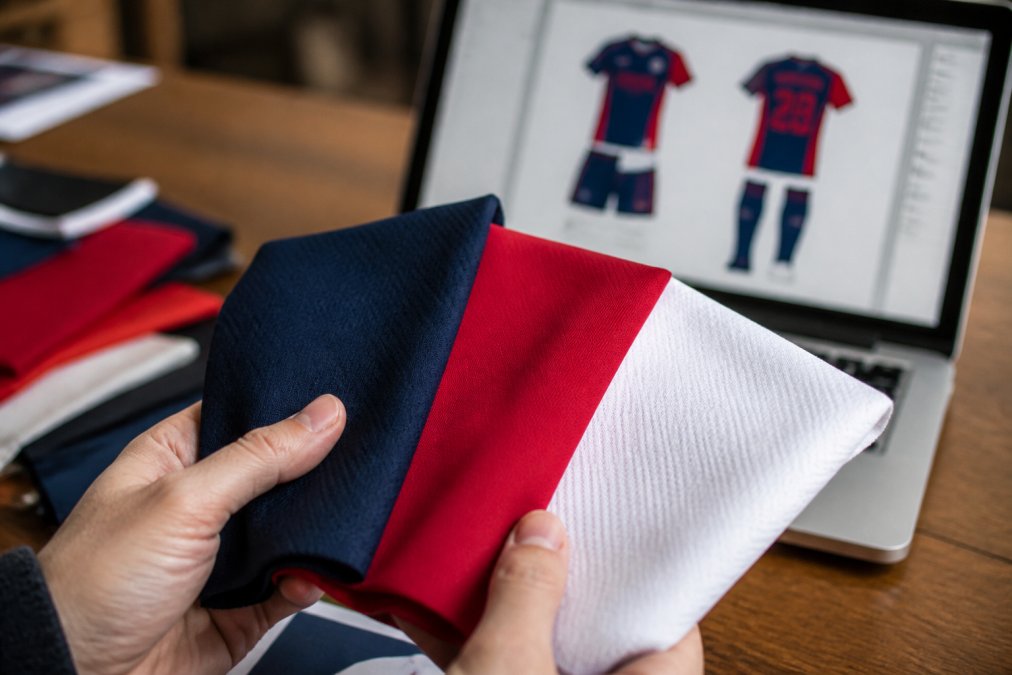
The revision loop is where most uniform orders stall. To simplify custom design revisions, treat the digital proof as a contract, not a suggestion. A digital proof is a virtual mockup showing exactly how your final garment will look, including logo placement, sizing, and color placement.
Before requesting changes, consolidate feedback from all decision-makers into a single list. One round of comprehensive feedback beats five rounds of piecemeal edits. Check the proof against your original vector artwork, confirm Pantone colors match expectations, and verify names and numbers are spelled correctly. Spelling errors caught at the proof stage cost minutes; errors caught after production cost weeks and money.
Managing Your Group Order and Sizing Logistics
Collecting sizes from a large group is often the most chaotic part of the process. A size chart alone is not enough. Ask each player for their actual measurements rather than their t-shirt size, as uniform cuts fit differently than casual apparel.
Create a simple roster spreadsheet with columns for name, jersey number, size, and special notes. This document becomes your single source of truth. Distribute it early and set a firm deadline for submissions. Late additions disrupt production schedules and can delay the entire order. For large groups, consider assigning a team manager to own the roster and be the single point of contact with your decorator.
Caring for Your Custom Uniforms to Extend Their Life
A quality uniform is an investment, and how you wash it determines how long the print lasts. The most common cause of premature cracking and peeling is improper washing. Turn garments inside out before washing to protect the printed surface from friction.
Wash in cold water and avoid fabric softeners, which can break down the adhesive in heat transfers. Tumble dry on low or, better yet, hang uniforms to dry. High heat is the enemy of both performance fabrics and decorative prints. These care steps keep your team looking sharp for multiple seasons, reducing the need for frequent reorders.
Conclusion: Bring Your Team Uniform Design to Life
Designing custom uniforms for your team is a process of careful planning, clear communication, and informed choices. By defining your needs, selecting the right printing method and fabric, and managing your group order efficiently, you set your team up for success before the first game. Action Designs specializes in high-quality, durable custom apparel using screen printing, embroidery, DTG, and DTF methods, with the flexibility to supply garments or customize items you provide. Get a quote and bring your uniform design to life with professional branding that lasts.
Frequently Asked Questions
How can I create custom team jerseys?
Start by choosing a jersey style and performance fabric that suits your sport. Prepare your team logo as a high-resolution vector file, like an AI or EPS, to ensure crisp printing. Then select a decoration method such as screen printing for solid logos. Work with a provider that allows you to approve a digital proof before production.
What are the best printing methods for custom team apparel?
The best method depends on your design and quantity. Screen printing is cost-effective for large orders with few colors and offers durable results. Embroidery gives a professional, textured look ideal for polo shirts and jackets. DTG (direct-to-garment) suits detailed, colorful artwork on cotton. For intricate designs, DTF (direct-to-film) transfers offer versatility across many fabric types.
How do I ensure my custom uniform colors match the final product?
Request a physical or digital proof before production. For precise brand colors, provide Pantone color codes to your decorator. Keep in mind that fabric type affects color; for example, sublimation on polyester can look different than screen printing on cotton. A reliable provider will confirm the garment color you select, helping prevent the surprise of a shade that doesn't match your expectations.
How do I manage sizing for a team uniform bulk order?
Ask your uniform provider for a detailed sizing chart and compare it to a current well-fitting garment. Collect sizes from your team members using an online spreadsheet to avoid errors.