 listicle
Best Quality Custom Hoodie Printing Services in 2026
Table of Contents
- What Defines Quality in Custom Hoodie Printing?
- Top Custom Hoodie Printing Services Compared
- Action Designs: Versatile Techniques for Any Order Size
- Custom Ink: Extensive Style Catalog with No Minimums
- Printful: Print-on-Demand for E-commerce Sellers
- Bolt Printing: Fast Turnaround for Bulk Fleece Orders
- UberPrints: Intuitive Design Studio for Custom Creations
- What the Comparison Misses: Hoodie Weight (GSM) as a Quality Filter
- Screen Printing vs DTG for Hoodies: Which Lasts Longer?
- Custom Hoodie Printing Minimum Order Quantities Explained
- How to Choose Custom Apparel Printing Services
- Which Custom Hoodie Service Should You Pick?
- Frequently Asked Questions
Last Updated: September 7, 2026
A great custom hoodie starts with the blank, not the print. The fabric weight, the cut, and the construction determine whether your design looks sharp for one season or holds up for years of wear.
Action Designs empowers brands and individuals to bring their unique visions to life through high-quality, durable custom apparel and promotional items. Below, we break down what defines quality, compare top services, and provide a framework for choosing the right partner based on your order size, design complexity, and timeline.
What Defines Quality in Custom Hoodie Printing?
Quality in custom hoodie printing comes down to three measurable factors: garment selection, ink application, and print durability. A service can nail two of these and still deliver a product that disappoints within months.
The garment matters more than most buyers realize. A standard 7.75 oz hoodie will hold a print differently than a heavyweight 12 oz fleece. Heavier fabrics provide a smoother surface for screen printing and resist the stretching that causes cracks and delamination over time.
Print durability separates professional operations from hobbyists. Screen printing pushes ink through a mesh stencil, creating a thicker layer that bonds with the fabric fibers. Direct-to-garment printing sprays water-based ink directly into the material. Both can last, but the outcome depends on the ink quality, the curing process, and the operator's skill.
Top Custom Hoodie Printing Services Compared
The market splits into print-on-demand platforms and traditional decorators. Quality isn't determined by which camp a service belongs to, it's determined by the blanks they stock, the equipment they run, and the quality control steps they take before your order ships.
Here's how the major players stack up, with an emphasis on the technical factors that separate a hoodie that looks sharp for one season from one that holds up for years.
Action Designs: Versatile Techniques for Any Order Size
Action Designs is a versatile option for custom hoodie printing. The team handles screen printing, embroidery, DTG, and DTF in-house, matching the printing method to your design.
A 7-color logo destined for 200 trade show hoodies calls for screen printing's opacity and cost efficiency at scale. An intricate Gen Z graphic with fine details and gradients needs the photographic range of DTG. Action Designs supports both, plus the ability to supply garments or decorate items you already own.
Production runs from single shirts to full collections, suiting small businesses and larger companies alike.
Custom Ink: Extensive Style Catalog with No Minimums
Custom Ink earns its reputation through selection, offering over 100 hoodie and sweatshirt styles from brand-name manufacturers, paired with an online design lab.
The no-minimum-order policy suits small groups and individuals wanting a single custom hoodie without screen printing setup fees. Their design interface is user-friendly, though pricing is quote-based.
Printful: Print-on-Demand for E-commerce Sellers
Printful solves a different problem. Rather than printing in bulk, it integrates with platforms like Shopify and fulfills orders directly to your customers.
This model eliminates inventory risk. The tradeoff is per-unit cost: DTG printing on demand carries a higher marginal cost than bulk screen printing, compressing your profit margin.
Bolt Printing: Fast Turnaround for Bulk Fleece Orders
Bolt Printing focuses on fleece hoodies and sweatshirts, with production timelines that appeal to teams and schools working against a season start date.
Its fleece specialization means Bolt Printing understands how different fabric weights accept ink. Bulk orders benefit from competitive pricing and free shipping. The main limitation is the 9-14 business day production window.
UberPrints: Intuitive Design Studio for Custom Creations
UberPrints differentiates itself through its interactive design studio, providing free images, templates, and text tools to build a design without graphic design software.
Instant quote generation helps with budget planning as prices update in real time. Free shipping on orders over $100 reduces costs for larger purchases.
What the Comparison Misses: Hoodie Weight (GSM) as a Quality Filter
The single most reliable predictor of print quality is the fabric weight of the blank garment, measured in grams per square meter (GSM). This metric separates a hoodie that feels like a paper bag from one that drapes like a premium garment.
Here's how GSM breaks down in practical terms:
| GSM Range | Weight Class | Typical Use | Print Surface Quality |
|---|---|---|---|
| 180-240 GSM | Lightweight | Layering, mild weather | Prone to stretching and distortion during printing |
| 250-300 GSM | Midweight | Everyday wear, year-round | Good balance of drape and print surface |
| 300-350 GSM | Heavyweight | Cold weather, premium feel | Smooth, stable surface; best for screen printing |
| 350+ GSM | Ultra-heavy | Winter weight, luxury blanks | Thickest surface; resists stretching and cracking |
When comparing services, ask: What GSM range do your standard blanks fall in, and can you source heavier blanks if needed? A service that only stocks lightweight blanks may be optimizing for profit margin rather than print quality.
Screen Printing vs DTG for Hoodies: Which Lasts Longer?
Screen printing lasts longer than DTG for most hoodie applications. The thicker ink deposit sits on top of the fabric, creating a more durable barrier against abrasion and washing.
Modern DTG printing has closed much of the gap. Water-based inks penetrate the fabric fibers, so the print won't crack or peel like older plastisol transfers. Durability now comes down to the garment and curing.
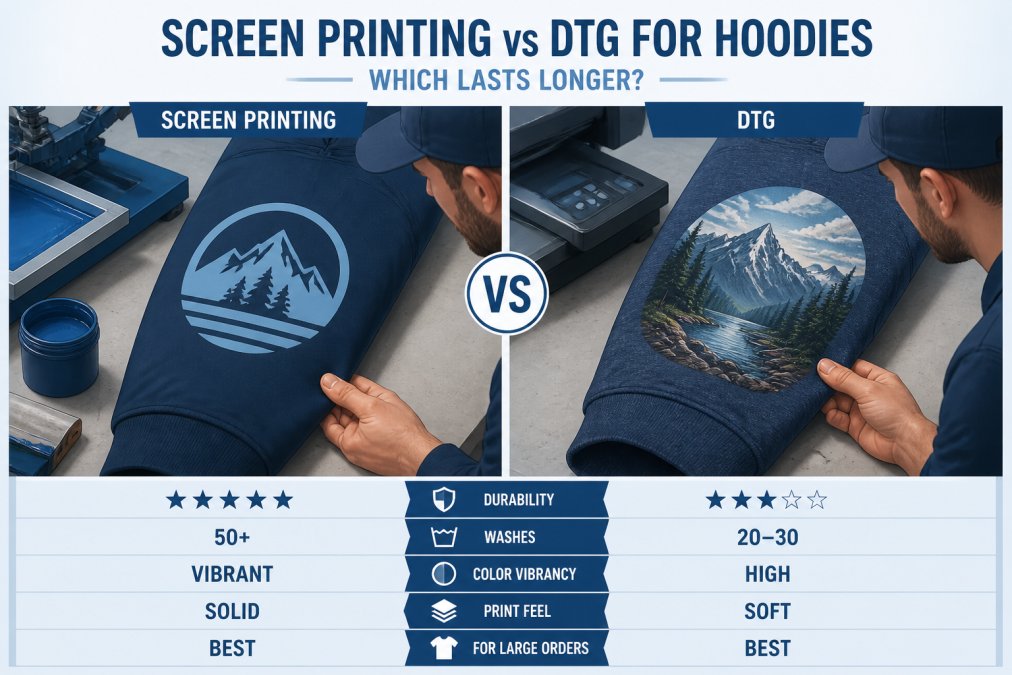
For solid logos with a limited color palette, screen printing remains the standard for longevity and opacity. For photographic designs or gradients, DTG produces results screen printing cannot match, though the print may show more wear over time.
Custom Hoodie Printing Minimum Order Quantities Explained
Minimum order quantities vary by printing method. Screen printing requires a minimum because each color needs a separate screen stretched, burned, and registered. That setup cost gets amortized across the order, so a 12-piece order carries a much higher per-unit price than a 144-piece order.
DTG and DTF printing eliminate screen setup entirely. The printer applies the design digitally, so a single hoodie costs nearly the same per unit as the 50th. This makes digital methods the clear choice for small orders, samples, and personalized items.
The table below summarizes how minimums and pricing behave across the main service types:
| Service Type | Typical Minimum | Best Order Size | Per-Unit Cost Trend |
|---|---|---|---|
| Screen Printing | 12-24 pieces | 50-500+ | Drops sharply with volume |
| DTG / DTF | No minimum | 1-50 pieces | Flat regardless of quantity |
| Embroidery | 1 piece | 1-100 pieces | Moderate setup, then flat |
| Print-on-Demand | No minimum | 1 piece at a time | Highest per-unit cost |
How to Choose Custom Apparel Printing Services
Choosing custom apparel printing services requires evaluating four variables: the garment, the print method, the turnaround, and the communication process. Most failed orders trace back to a mismatch in one of these areas.
Start by defining your order size and design complexity. A 20-piece order with a one-color logo points toward DTG or embroidery. A 200-piece order with a four-color logo points toward screen printing. Forcing a design into the wrong method inflates cost or degrades quality.
Evaluate Fabric Weight and Garment Quality
The garment blank determines how your print looks and lasts. Lightweight hoodies around 7 oz wrinkle and stretch more during printing. Midweight options from 8.5 to 9.5 oz offer the best balance of drape and print surface. Heavyweight fleece above 10 oz provides the smoothest surface and most durable product.
Ask your printer which blanks they stock and whether they offer options from different manufacturers. A printer that pushes a single brand may be prioritizing their margin over your needs.
Review Print Durability and Wash Fastness
Wash fastness describes how well a print survives repeated washing. Screen prints with proper curing can last the life of the garment. DTG prints typically show gradual fading after 25-50 washes (impressionsmagazine.com).
Ask your provider how they cure their prints and whether they test wash fastness on new garment blanks. Established providers maintain quality control procedures that verify ink adhesion before orders ship. The ASTM International standards for textile testing provide a useful reference for evaluating print durability claims.
Prepare Your Artwork Correctly: The File Prep Guide Most Services Won't Give You
Most custom hoodie order failures happen in the artwork file before it's uploaded. Beginners routinely submit files that are too low-resolution, in the wrong color space, or in a format the printer can't use, and then blame the printer for a blurry result.
Vector files (AI, EPS, PDF, SVG) store artwork as mathematical paths, scaling to any size without losing sharpness, ideal for logos and text. Raster files (PNG, JPG, TIFF) store artwork as a grid of pixels with fixed resolution; enlarging them causes pixelation.
For screen printing, artwork should be at least 300 DPI at the final print size (printing.org). A logo that looks crisp at 72 DPI on screen will look blurry across a hoodie chest. For DTG, the same 300 DPI minimum applies, though some printers recommend 600 DPI for fine details.
Color profiles are the third common failure point. Most digital designs are created in RGB, the color space of screens. Printing uses CMYK or spot colors. When an RGB file is converted to CMYK without proper adjustment, colors shift, sometimes dramatically.
Here's a practical checklist to run through before you upload any file:
- Confirm the file format. Ask your printer which formats they accept. Most prefer vector files for screen printing and high-resolution PNGs for DTG.
- Check the DPI. Open your file properties and verify the resolution is at least 300 DPI at the final print size.
- Convert to CMYK if required. If your printer requests CMYK, convert your file and review the colors before submitting.
- Embed fonts or convert to outlines. If your design includes text, convert it to outlines or curves so the printer's system doesn't substitute a different font.
- Include a bleed area. If your design extends to the edge of the print area, add 1/8 inch of bleed so trimming doesn't cut into your artwork.
A quality-focused printing service will review your artwork before production and flag potential issues. If a provider accepts your file without asking about resolution or format, that's a warning sign.
Which Custom Hoodie Service Should You Pick?
The right custom hoodie printing service depends on your needs. Action Designs offers a versatile combination of techniques, with screen printing, embroidery, DTG, and DTF all available in-house, for organizations needing professional-grade results across multiple order sizes and design types.
For e-commerce sellers wanting to avoid inventory, Printful's platform integration removes fulfillment friction. For teams and schools ordering bulk fleece on a deadline, Bolt Printing delivers reliable timelines. For individuals designing a single hoodie, Custom Ink and UberPrints provide accessible online tools.
The decision comes down to whether you need a partner or a platform. Platforms optimize for convenience and self-service. Partners optimize for print quality and design consultation. If your branding matters beyond a single season, the extra conversation with a knowledgeable decorator pays for itself.
Frequently Asked Questions
What is the best printing method for custom hoodies?
The best method depends on your design and order size. Screen printing offers the most durable results for bulk orders with limited colors and is cost-effective at higher quantities. Direct-to-garment (DTG) excels at intricate, multi-colored designs with no minimum order, making it ideal for smaller batches. For hoodies, consider the fabric weight and your design complexity. A provider like Action Designs can recommend the right technique based on your artwork and budget.
How do I choose a high-quality custom hoodie printing service?
Look for a provider that offers multiple printing techniques, including screen printing, embroidery, DTG, and DTF, so you get the right method for your design. Evaluate their garment options, checking fabric weights measured in GSM, and ask about print durability and wash fastness. Review their proofing process for color matching accuracy and confirm their minimum order quantities fit your needs. A partner that can handle both small and large orders offers the most flexibility.
Is screen printing or DTG better for custom hoodies?
Screen printing is the better choice for large orders because it produces vibrant, durable prints at a lower per-unit cost. DTG is better for small orders or designs with many colors and fine details, since it prints digitally without setup fees. For hoodies that get washed frequently, screen printing typically offers superior longevity, while DTG provides a softer hand-feel. Many professional shops suggest screen printing for logos and DTG for photographic or highly detailed artwork.
Can I provide my own hoodies for custom printing?
Yes, many custom hoodie printing services accept client-provided garments. This option is useful if you have specific brand preferences or already purchased blank hoodies. Confirm the provider can handle the fabric type and that your garments meet their quality standards, as printing on low-quality blanks can affect results.
What are the minimum order requirements for custom hoodie printing?
Minimum order quantities vary significantly by provider and printing method. Screen printing often requires higher minimums, sometimes 25 to 50 pieces, to justify setup costs. Direct-to-garment printing and print-on-demand services typically have no minimum order, making them ideal for small teams or personal projects. If you need a small batch with a complex design, look for a provider that offers DTG or DTF printing without quantity restrictions.
The challenge with custom hoodie printing isn't finding a company that can print. It's finding one that prints well, communicates clearly, and delivers on time. Action Designs combines multiple printing techniques with scalable production, so whether you need one hoodie or a full collection, your design gets the method it deserves. Get a quote and see the difference that professional-grade customization makes for your next order.