 listicle
Best Custom Apparel Printing Techniques 2026
Table of Contents
- Quick Comparison of Custom Apparel Printing Techniques
- Direct-to-Garment (DTG) Printing: Color Vibrancy and Detail
- DTG vs DTF Printing Comparison: Which Delivers Better Results
- Screen Printing vs Embroidery for Uniforms: Durability and Professional Appeal
- Cost-Effective Apparel Printing Methods by Order Volume
- Sublimation and Heat Transfer Vinyl: Specialty Printing for Synthetic Fabrics
- How to Choose the Right Custom Apparel Printing Technique
- Conclusion
- Frequently Asked Questions
Last Updated: September 2, 2026
Quick Comparison of Custom Apparel Printing Techniques
Choosing the right custom apparel printing technique depends on your order volume, design complexity, fabric type, and durability requirements. Each method delivers different results, and the "best" choice varies based on your specific situation.
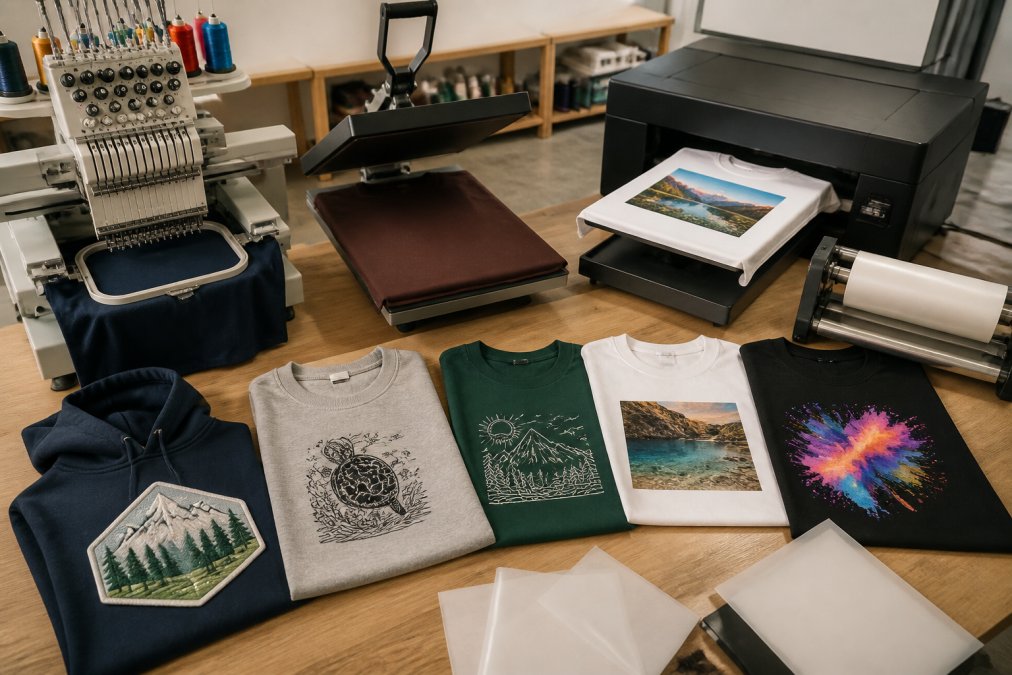
Direct-to-Garment (DTG) and Direct-to-Film (DTF) printing now compete with screen printing for mid-volume orders. Sublimation dominates synthetic fabrics. Heat Transfer Vinyl (HTV) remains most cost-effective for small runs. Embroidery commands premium pricing for professional uniforms and corporate branding.
At Action Designs, we work across all these methods, giving us visibility into where each excels. This guide shows you exactly which technique solves your specific problem.
| Printing Technique | Best For | Durability | Setup Cost | Per-Unit Cost (100+ units) | Design Complexity |
|---|---|---|---|---|---|
| DTG Printing | Full-color designs, photo-realistic prints | 50-100+ washes | Low to moderate | Moderate | Unlimited colors |
| DTF Printing | Dark and light garments, vibrant colors | 50-100+ washes | Moderate | Moderate to high | Unlimited colors |
| Screen Printing | Bulk orders, spot colors, maximum durability | 200+ washes | High | Low | 1-6 colors optimal |
| Sublimation | Polyester and blends, all-over prints | 50-100+ washes | Moderate | Moderate | Unlimited colors |
| Heat Transfer Vinyl (HTV) | Small orders, simple designs, quick turnaround | 20-50 washes | Very low | Low to moderate | Simple shapes, 1-2 colors |
| Embroidery | Uniforms, corporate branding, premium feel | 500+ washes | High | High | Limited detail, thread colors |
Direct-to-Garment (DTG) Printing: Color Vibrancy and Detail
Direct-to-Garment printing applies water-based ink directly onto fabric using inkjet technology, creating photo-realistic designs with unlimited color options. A design with 50 colors costs the same to print as one with two colors because there are no setup fees.
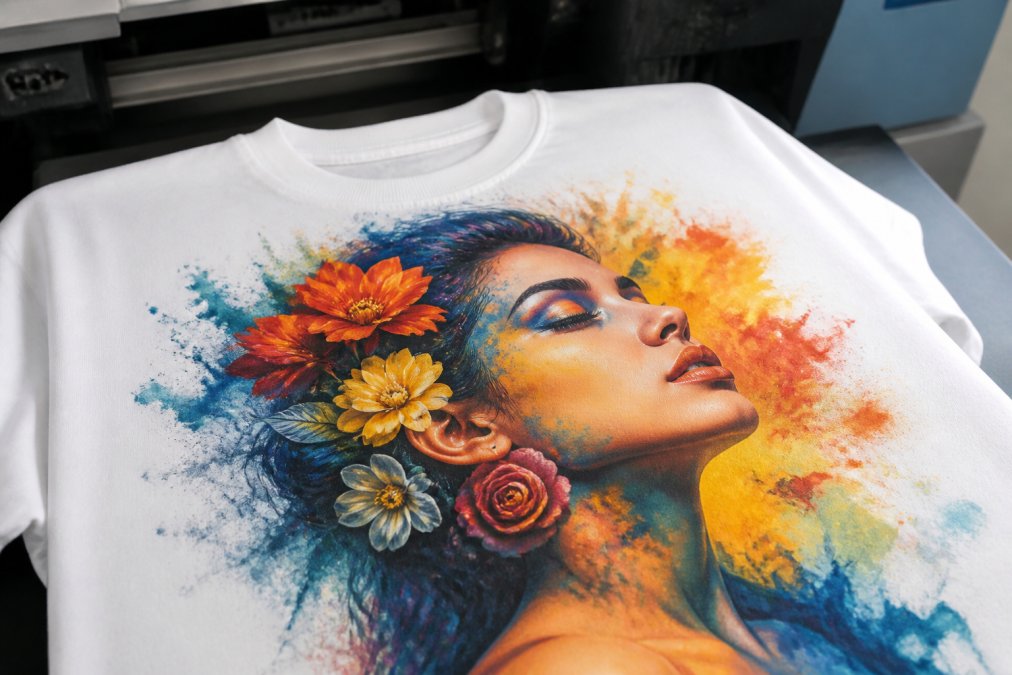
DTG works best on light-colored, 100% cotton garments. Dark garments require a white underbase layer, which adds curing time and reduces soft-hand feel. Polyester and synthetic blends don't accept water-based inks as well, leading to inconsistent color penetration. Regular maintenance is required, and clogged nozzles are common.
Durability runs 50-100+ washes with proper curing (peer-reviewed research). Undercured prints crack and peel faster. Many DTG operations rush curing to increase throughput, causing customer failure within 10-15 washes.
For orders under 500 units with complex, full-color artwork, DTG is often most cost-effective because there's no setup fee.
DTG vs DTF Printing Comparison: Which Delivers Better Results
Direct-to-Film (DTF) printing creates a design on special transfer film, cures it, then applies the transfer using a heat press. This extra step unlocks capabilities DTG cannot match.
DTF works on virtually any fabric: dark cotton, polyester, nylon, blends, even leather. The design looks consistent regardless of fabric composition. A DTF print on black polyester looks identical to the same design on white cotton.
Durability matches DTG at 50-100+ washes. DTF requires more equipment: a dedicated DTF printer, powder shaker, heat press, and quality transfer film. Per-unit costs run slightly higher than DTG for small orders because of transfer film costs.
DTF's real advantage emerges with dark garments. DTG on black requires a white underbase, limiting design placement. DTF prints directly onto dark fabric without an underbase, enabling full-bleed capability and faster production.
Choose DTG for light-colored 100% cotton with complex artwork. Choose DTF for flexibility across multiple fabric types, dark garments, or full-bleed designs.
Screen Printing vs Embroidery for Uniforms: Durability and Professional Appeal
Screen printing and embroidery dominate the uniform market because both deliver durability that outlasts other techniques by years.
Screen printing forces ink through a mesh screen onto fabric, creating prints lasting 200+ washes (peer-reviewed research). Spot colors produce vibrant, opaque coverage that photographic prints cannot match. A bright red logo looks more vivid than the same design in DTG.
Embroidery stitches thread directly through fabric using a computerized machine. The stitched design lasts 500+ washes without fading (peer-reviewed research). Embroidered logos convey premium quality and durability that printed designs struggle to match.
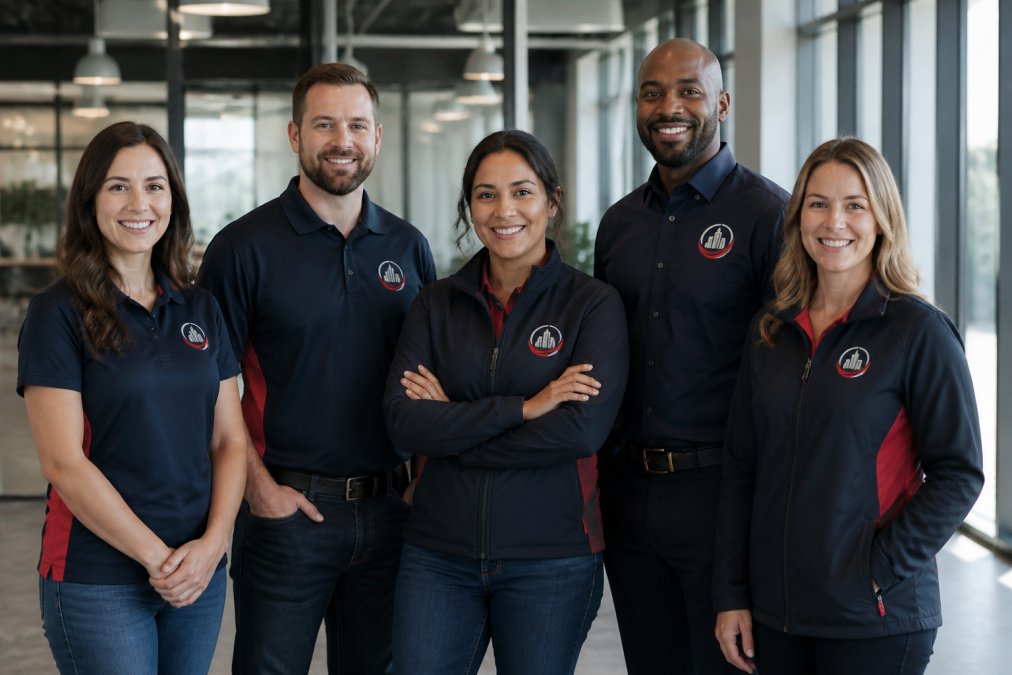
Screen printing requires separate screens for each color, with setup costs making sense only for orders above 50-100 units. Embroidery requires digitizing artwork and machine setup, with per-unit costs remaining high even on large orders.
Both techniques struggle with fine detail. Screen printing loses detail in the mesh; embroidery makes thin lines thick and small text illegible.
For uniforms, embroidery wins on durability and professional appearance. For high-volume branded merchandise, screen printing wins on cost-per-unit. Many operations use both: embroidered logos on polo shirts for professional settings, screen-printed designs on t-shirts for events.
Cost-Effective Apparel Printing Methods by Order Volume
The most cost-effective printing technique changes based on order quantity.
For 1-25 units: Heat Transfer Vinyl (HTV) is unbeatable. No setup fees, fast turnaround, and simple designs cost $3-8 per unit. DTG works but may require minimum orders.
For 25-100 units: DTG and DTF become attractive because they eliminate setup fees. Per-unit costs drop to $5-12 depending on design complexity. HTV still works but loses its cost advantage.
For 100-500 units: Screen printing enters the conversation. Setup costs ($50-150 per color) spread across 100+ units, making per-unit costs competitive with DTG at roughly $4-6 per unit for a 3-color design.
For 500+ units: Screen printing dominates at $2-4 per shirt for simple designs. Embroidery becomes viable for uniforms when volume justifies per-unit cost.
Sublimation and Heat Transfer Vinyl: Specialty Printing for Synthetic Fabrics
Sublimation converts solid dye into gas using heat and pressure, bonding permanently with polyester fibers. Colors remain vibrant indefinitely because the dye embeds in the fiber itself.
Sublimation works only on light-colored polyester and blends. Dark polyester doesn't work because the dye has nowhere to bond. All-over designs with complex gradients look stunning on sublimated polyester.
Heat Transfer Vinyl (HTV) cuts vinyl sheets into designs and applies them using a heat press. It's the most accessible entry point into custom apparel printing with minimal equipment costs and a gentle learning curve.
HTV durability depends on vinyl quality and heat press settings. Budget vinyl cracks after 20-30 washes; premium vinyl lasts 50+ washes. Thick vinyl creates a stiff texture; thin vinyl feels better but wears faster.
HTV excels at small orders and quick turnaround. A single custom shirt takes 15-20 minutes. The design limitation is significant: you're limited to solid colors and simple shapes. Gradients and photographic images don't work well.
Choose sublimation for polyester performance wear and all-over prints where color vibrancy matters. Choose HTV for small orders, quick turnaround, and simple designs on light cotton.
How to Choose the Right Custom Apparel Printing Technique
The decision framework depends on five variables: order volume, fabric type, design complexity, durability requirements, and timeline.
Step 1: Identify your fabric. Cotton works with all techniques. Polyester limits you to DTF, sublimation, or embroidery. Dark garments eliminate DTG and sublimation.
Step 2: Define your design. Simple logos with 1-2 colors work with HTV, screen printing, or embroidery. Complex, photo-realistic designs require DTG or DTF. All-over prints need sublimation or DTF.
Step 3: Set your volume threshold. Under 50 units, DTG and HTV dominate. 50-200 units favor DTG and DTF. Over 200 units, screen printing becomes cost-competitive. Over 500 units, screen printing wins decisively.
Step 4: Determine durability needs. Casual merchandise survives 20-50 washes. Uniforms need 200+ washes. Embroidery is the only technique guaranteeing 500+ wash durability.
Step 5: Consider timeline. DTG and HTV offer fastest turnaround. Screen printing and embroidery require setup time.
| Your Situation | Best Technique | Second Choice | Avoid |
|---|---|---|---|
| Small order (under 25), light cotton, simple design | HTV | DTG | Screen printing |
| Medium order (50-200), light cotton, complex design | DTG | DTF | HTV |
| Medium order (50-200), dark garment | DTF | Screen printing | DTG |
| Large order (500+), simple design, maximum durability | Screen printing | Embroidery | DTG |
| Polyester, all-over design, vibrant colors | Sublimation | DTF | Screen printing |
| Uniform branding, premium appearance | Embroidery | Screen printing | HTV |
Action Designs works across all techniques, allowing us to recommend the method that solves your problem rather than pushing what we specialize in.
Conclusion
The best custom apparel printing technique depends entirely on your order volume, fabric type, design complexity, and durability requirements. There's no universal winner, only the right choice for your situation.
DTG delivers unlimited colors and fast turnaround for small-to-medium orders on light cotton. DTF adds flexibility across fabric types and dark garments. Screen printing dominates large orders. Sublimation creates vibrant designs on polyester. HTV offers the fastest entry point for small orders. Embroidery delivers unmatched durability for uniforms.
Most businesses choose based on vendor recommendations rather than actual requirements. Action Designs offers multiple techniques, screen printing, embroidery, DTG, and DTF, because different jobs need different solutions. We can supply blank garments or customize items you provide, scaling from single shirts to full collections.
GET A QUOTE from Action Designs and describe your specific project. Tell us your order volume, fabric preference, design complexity, and timeline. We'll recommend the technique that delivers the best quality at the best price for your situation.
Frequently Asked Questions
What is the most durable custom apparel printing technique?
Screen printing offers exceptional durability for custom apparel, with prints lasting through hundreds of wash cycles when properly cured. The ink sits on top of the garment substrate and bonds through heat, creating a soft-hand feel that doesn't crack or peel. DTG printing also delivers strong wash durability, especially on 100% cotton garments with proper ink adhesion. For maximum longevity on synthetic fabrics, sublimation creates permanent color bonding that won't fade or crack. Your choice depends on garment type and design complexity.
How do DTG vs DTF printing comparison affect my final product quality?
DTG printing applies ink directly to the garment, delivering excellent color vibrancy and fine detail on cotton and cotton-blend fabrics. DTF printing applies ink to a transfer film first, then transfers it to any fabric type, offering superior results on synthetic fibers and dark garments. DTG provides a softer hand feel and better breathability, while DTF excels at color consistency and durability on polyester and blends. Both handle complex artwork and raster graphics well, but DTG works best for natural fibers while DTF is ideal for performance and synthetic fabrics.
Which printing method works best for low-quantity orders?
DTG and DTF printing are ideal for low-quantity orders because they require no screen setup or mesh preparation. You can print single shirts profitably without the high setup costs of screen printing. Heat transfer vinyl (HTV) works well for 1-50 unit runs on simple designs. Screen printing becomes cost-effective only at batch sizes of 50+ units, where the per-print cost drops significantly. For custom apparel printing methods that scale from one shirt to hundreds, DTG and DTF offer the most flexibility and lowest cost-per-print on small orders.
How does screen printing compare to embroidery for uniforms?
Screen printing delivers vibrant, detailed graphics quickly and cost-effectively for bulk uniform orders, with excellent wash durability and color vibrancy. Embroidery creates a dimensional, professional look that conveys quality and prestige, making it ideal for corporate branding and upscale uniforms. Screen printing handles multi-color designs and photographic artwork better, while embroidery excels with logos and text. For uniform durability, both methods last for years with proper care. Screen printing costs less per unit on large orders, while embroidery justifies higher per-unit costs through perceived quality and professional appearance.
What proof shows that custom apparel printing quality actually lasts?
Professional screen printing shops test wash durability following industry standards for color retention and ink adhesion. DTG and DTF prints maintain color vibrancy through 50+ home wash cycles when printed on quality garments with proper curing. Embroidered designs withstand hundreds of washes without thread degradation. Sublimation prints on polyester are permanent and won't fade or peel. The key factors determining longevity are garment quality, ink type, curing process, and proper washing. Action Designs uses commercial-grade inks and equipment across all printing techniques to ensure your custom apparel maintains its appearance through extended use and regular washing.
What's your order volume and fabric type? These two variables alone determine which technique makes sense. Share your project details, and we'll provide a transparent quote showing exactly which method solves your problem.
This article was written using GrandRanker